
Views: 29 Author: Wang Publish Time: 2024-07-11 Origin: Site


Incoloy alloy is a range of superalloys produced by JN Alloy. They are nickel-iron-chromium alloys used for applications requiring high corrosion resistance and high-temperature strength. Incoloy 825 is a nickel-iron-chromium alloy with additions of molybdenum, copper, and titanium. The alloy's chemical composition provides exceptional resistance to many corrosive environments.
The Nickel content is sufficient for resistance to chloride-ion stress corrosion cracking. Nickel plus molybdenum and copper also resists reducing environments like sulfuric and phosphoric acid.
The molybdenum also aids resistance to pitting and crevice corrosion. Chromium in the alloy resists many oxidizers like nitric acid, nitrates, and oxidizing salts. The titanium addition, with appropriate heat treatment, will stabilize the alloy against sensitization to intergranular corrosion.
Nickel Alloy 825 bar, rod, and wire is a nickel-iron-chromium alloy with molybdenum, copper, and titanium. The alloy's chemical composition is designed to provide exceptional resistance to many corrosive environments. The nickel content is sufficient for resistance to chloride-ion stress-corrosion cracking.
Combined with molybdenum and copper, nickel also provides excellent resistance to reducing environments like sulfuric and phosphoric acids. The molybdenum also aids resistance to pitting and crevice corrosion. And the titanium addition serves to stabilize the alloy—following appropriate heat treatment—against sensitization to intergranular corrosion.
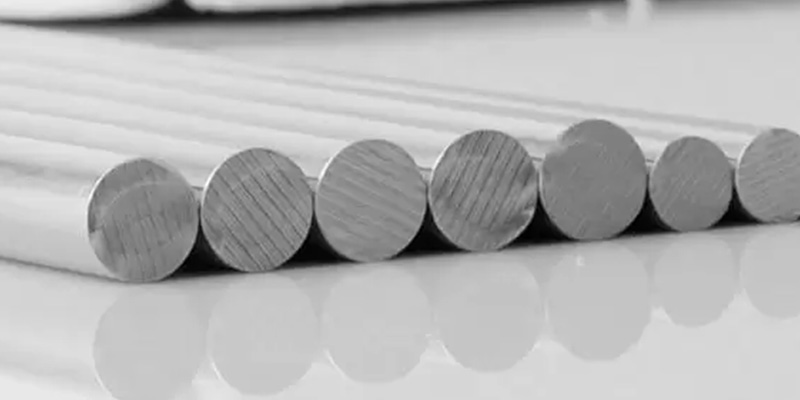
JN Alloy is an Alloy 825 bar manufacturer, from ¾” up to 10” in a large number of different sizes.

Incoloy 825, developed from Incoloy 800 for superior sulfuric acid resistance, was commercialized in 1952. Copper additions are well-known to improve resistance to reducing environments, such as sulphuric acid. Ferralium 255 (2% Cu) and Alloy 20 (3-4% Cu) also exploit this property effectively. The nickel content of Incoloy 825 makes it resistant to chloride stress corrosion cracking.
Incoloy 825’s molybdenum-copper alloy provides superior corrosion resistance in reducing environments compared to other austenitic stainless steels. The chromium and molybdenum make it more resistant to chloride pitting and oxidizing atmospheres. The titanium can stable the alloy against sensitization in the as-welded condition. Incoloy 825 resists both stress corrosion cracking and pitting in most environments, except in strongly oxidizing chloride solutions.
The high nickel content provides stress corrosion cracking resistance. Combined with molybdenum and copper, it strongly withstands reducing environments like sulfuric and phosphoric acids. Chromium resists oxidizing environments such as nitric acid, while titanium inhibits intergranular corrosion.
Overall pitting and crevice corrosion resistance is enhanced. Incoloy 825's superior corrosion resistance enables its use in industries like chemical processing, pollution control, oil and gas recovery, and nuclear fuel reprocessing.
Incoloy 825 Round Bar Specification:
Specification | ASTM B425 UNS N08825, SB 425 |
Standard | ASTM, ASME, API, GB, AISI, DIN, EN, SUS, UNS |
Alloy 825 Round bar size | Diameter: 3~800mm |
ASTM B425 N08825 Angle bar size | 3*20*20mm~12*100*100mm |
Nickel Alloy 825 Square bar size | 4*4mm~100*100mm |
B425 N08825 Billet Size | 1/2" to 495mm Diameter |
2.4858 Incoloy 825 Rectangles Size | 33 x 30mm to 295 x 1066mm |
Finish | Bright, Polish, Bright, Rough Turned, Grinding, Centreless Ground & Black |
Tolerance | H8, H9, H10, H11, H12, H13, K9, K10, K11, K12 or as per clients’ requirements |
Surface | Hot Rolled Pickled or Sand Blasting Finished, Cold Drawn, Bright, Polished, Hairline |
Condition | Cold Drawnd Pulished Cold Drawn Centreless Ground & Polished, Annealed |
Technique | ASTM B425 Gr 825 Hot Rolled, Cold Rolled, Cold Drawn, Forged |
Where we export | USA, UAE, Malaysia, Poland, Singapore, Canada, Australia, Iran, UK, Italy |
Form | Round, Rod, Ingot, Billet, Rings, Hex, T-Bars, Precision-Ground, Rectangle, Forging, Half-Round, Blocks, Angle, I/H, Hollow, Flat, Round-Rod, Square, Triangle, Profiles, Channel, Threaded |

Alloy 825 bar is a compound metal alloy with a high nickel content product. Due to various metal inclusions, UNS N08825 possesses high corrosion resistance and favorable mechanical properties. Demonstrating broad usefulness with optimum machining characteristics and good weldability, Incoloy 825 is an ideal metal alloy for strenuous applications and corrosive environments.
The high nickel content prevents stress corrosion cracking, while copper and molybdenum enhance resistance to phosphoric and sulfuric acids. Including molybdenum compounds also reduces pitting and crevice corrosion from surface layer oxidization. Additionally, the chromium content provides additional resistance to other oxidizing substances, like nitric acid, nitrates, and salt. To protect against intergranular corrosion, Incoloy alloy 825 rod also features titanium for increased stability.
UNS N08825 bar can withstand exposure to cryogenic temperatures and moderately high temperatures. However, microstructural changes can occur when exposed to temperatures above 1000 degrees Fahrenheit. Incoloy alloy 825 bar has a maximum tensile strength of 104,000 psi and exceptional yield strength. It has good impact strength at room temperature and can retain its strength at subzero temperatures.
Incoloy 825 rod can be readily hot or cold worked. Hot working should be in the range 870 – 1180°C, finishing at 870 – 980°C. For maximum corrosion resistance hot worked parts should be stabilise annealed before use. The alloy is easier to cold form than stainless steels.
Incoloy 825 bar is stabilise annealed at 940°C. The softest structure is obtained at 980°C. Sections heavier than sheet, strip and wire should be quenched to avoid sensitisation.
Typical Applications of Incoloy 825 bars include:
Sulphuric acid piping and vessels
Phosphoric acid evaporators
Pickling tank heaters, pickling tanks and equipment
Chemical process equipment
Propellor shafts
Tank trucks
Calorifiers
Electrostatic precipitator electrodes
Hot vessels for food, water and seawater,
Ammonium sulphate vessels
Expansion bellows
Marine exhaust systems
Power station ash hoppers


