
Views: 36 Author: Shirley Publish Time: 2025-07-07 Origin: Site


Duplex 2205 stainless steel is a two-phase alloy - roughly half ferrite, half austenite - that delivers about twice the yield strength of 316L and far better resistance to chloride pitting and stress corrosion cracking, while costing noticeably less than super duplex 2507 or a 6-moly super-austenitic grade. That combination is why 2205 has become the default upgrade whenever 316L fails in chloride service, and the default value choice whenever super duplex has been over-specified.
JN supplies 2205 in both chemistries - UNS S31803 (F51) and the tighter UNS S32205 (F60) - across plate, sheet, pipe, tube, round bar, flanges and forged fittings. Material is delivered solution annealed and water quenched to ASTM A240, ASTM A790, ASTM A789, ASTM A182, A276, A479 and A815, with EN 10204 3.1 or 3.2 certification and NACE MR0175 / ISO 15156-3 compliance available on request. Start from the duplex and super duplex stainless steel hub if you are still deciding between the duplex families.
| Property | Value | Why it matters when you buy |
|---|---|---|
| Common designations | 2205, UNS S31803 (F51), UNS S32205 (F60), EN 1.4462, WNR 1.4462, 00Cr22Ni5Mo3N | Always order by UNS number, never by '2205' alone |
| Microstructure | Roughly 50% ferrite / 50% austenite (typically 35-55% ferrite by measurement) | This two-phase structure is where the strength and the SCC resistance come from |
| Density | 7.8 g/cm3 (0.28 lb/in3) | Weight and freight estimates for plate and bar |
| Yield strength, min. | 450 MPa (65 ksi) for both S31803 and S32205 | About 2.6x the 170 MPa minimum of 316L - thinner walls, lighter sections |
| Tensile strength, min. | 620 MPa (90 ksi) S31803 / 655 MPa (95 ksi) S32205 | Check which UNS the drawing calls for before you quote |
| Elongation, min. | 25% in 2 in. (50 mm) | Confirms the grade was supplied annealed, not cold-worked |
| Hardness, max. | 293 HBW / 31 HRC (ASTM A240) | Also the acceptance gate for NACE MR0175 sour service |
| PREN (Cr + 3.3Mo + 16N) | S31803 approx. 30-34; S32205 approx. 34-36 as supplied | The single number that separates 2205 from 316L and from super duplex |
| Magnetic? | Yes, weakly - the ferrite phase is ferromagnetic | Do not use 'non-magnetic' as an acceptance test for 2205 |
| Continuous service temperature | About -50 degC to 300 degC (-58 degF to 572 degF) | Above about 300 degC, 475 degC embrittlement and sigma phase become the limit |
| Solution anneal | 1040 degC (1900 degF) minimum, water quench | The heat treatment you must see on the mill test report |
| Welding filler | ER2209 / E2209 (ISO 22 9 3 N L) | Matching filler restores phase balance in the weld |
| Governing standards | ASTM A240, A182, A276, A479, A789, A790, A815; ASME SA equivalents; NACE MR0175 / ISO 15156-3 | Name the standard and the edition on the purchase order |
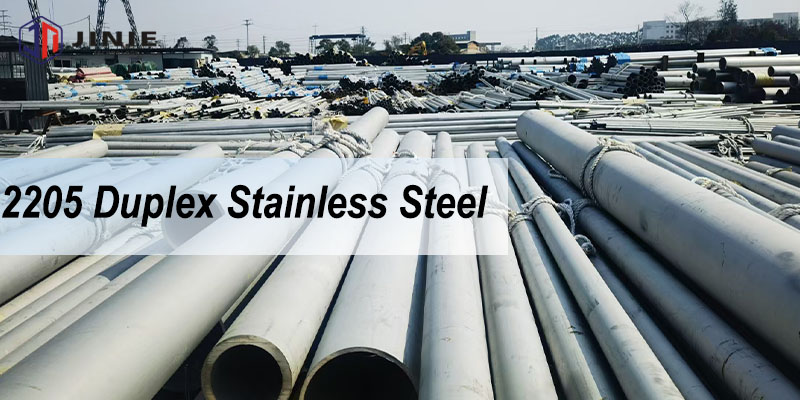
2205 is a ferritic-austenitic stainless steel - about half ferrite and half austenite - with roughly 22 percent chromium, 5-6 percent nickel, 3 percent molybdenum and 0.14-0.20 percent nitrogen in the S32205 chemistry. The mixed structure is what gives it about twice the yield strength of an austenitic grade and much better resistance to chloride stress corrosion cracking.
The ferrite phase carries the strength and the resistance to stress corrosion cracking; the austenite phase carries toughness and ductility. Because 2205 sits in both camps, it behaves differently from the 300-series stainless most buyers are used to: it is magnetic, it work-hardens faster, its springback on bending is larger, and it has a hard ceiling on service temperature. None of those are defects - they are simply the trade you make for the strength and the chloride performance.
JN Duplex Steel 2205 products are supplied and certified as follows:
In most environments 2205 offers high general corrosion resistance. The high chromium content handles oxidising acids, while the molybdenum and nickel content handles reducing acids. Its resistance to chloride pitting and crevice corrosion sits between that of 316L stainless steel and that of super duplex 2507.
Duplex 2205 Composition (%) | C | Si | Mn | P | S | Cr | Ni | Mo | N |
Standard | ≤0.03 | ≤1.00 | ≤2.00 | ≤0.04 | ≤0.03 | 21.0~24.0 | 4.5~6.5 | 2.5~3.5 | 0.08~0.2 |
Normal | 0.025 | 0.6 | 1.5 | 0.026 | 0.001 | 22.5 | 5.8 | 3.0 | 0.16 |
S32205 is the tighter, higher-alloy version of S31803: more chromium, more molybdenum and more nitrogen, all inside narrower bands. The mechanical minimums are identical, so the upgrade is chemical - and it shows up as a higher pitting resistance equivalent number and more consistent corrosion behaviour.
This matters commercially because the word "2205" on a drawing does not tell the mill which chemistry you want. If the equipment sees chlorides, seawater, brine or sour gas, specify UNS S32205 and require the calculated PREN on the certificate. If the duty is mild and the driver is strength, S31803 will do the job at a lower price. Where the risk is unclear, ask for dual certification to both designations, which most mills can supply from a single heat.
| Element / property | UNS S31803 (F51) | UNS S32205 (F60) | Why the difference matters |
|---|---|---|---|
| Chromium, % | 21.0 - 23.0 | 22.0 - 23.0 | Tighter and higher floor lifts the PREN and the pitting resistance |
| Molybdenum, % | 2.5 - 3.5 | 3.0 - 3.5 | Higher floor is the single biggest lever on crevice corrosion |
| Nickel, % | 4.5 - 6.5 | 4.5 - 6.5 | Identical; sets the austenite fraction and the phase balance |
| Nitrogen, % | 0.08 - 0.20 | 0.14 - 0.20 | Higher floor stabilises austenite and raises PREN by 16x the nitrogen |
| Carbon, max % | 0.030 | 0.030 | Identical; low carbon limits sensitisation |
| Manganese, max % | 2.00 | 2.00 | Identical |
| Silicon, max % | 1.00 | 1.00 | Identical |
| Phosphorus, max % | 0.030 | 0.030 | Identical |
| Sulfur, max % | 0.020 | 0.020 | Identical; low sulfur helps hot workability and toughness |
| Tensile strength, min. | 620 MPa (90 ksi) | 655 MPa (95 ksi) | S32205 minimum is slightly higher in mill practice |
| Yield strength, min. | 450 MPa (65 ksi) | 450 MPa (65 ksi) | Identical - the upgrade is chemical, not mechanical |
| Elongation, min. | 25% | 25% | Identical |
| Hardness, max. | 293 HBW / 31 HRC | 293 HBW / 31 HRC | Identical |
| Typical PREN as supplied | approx. 30 - 34 | approx. 34 - 36 | The number to put on the mill test report |
| Typical use | General industrial, strength-driven work | Chloride, seawater, brine and sour duty | Buy S32205 whenever chlorides are the reason for upgrading |
Both designations carry the same forging grade family - S31803 is F51 and S32205 is F60 - and both are recognised across the whole duplex product-form standard set. See what is duplex S31803 and a guide to duplex stainless steel S32205 for the full chemistry discussion, and 2205 versus super duplex 2507 for the next step up.
Duplex stainless steel is a family of grades, not a single grade. The family splits into four tiers - lean, standard, super and hyper duplex - and 2205 sits in the standard tier. Pick the tier by the PREN you need, not by the name on the datasheet.
The tiers are separated mainly by chromium, molybdenum and nitrogen, which is exactly what the PREN formula rewards. Lean grades trade corrosion resistance for lower and more stable cost; standard grades such as 2205 balance the two; super and hyper grades push chloride performance as far as a stainless steel can go before you have to move to a nickel alloy. The full naming logic is set out in the numbering system for duplex stainless steels.
| Tier | Typical PREN | Representative grades | JN product pages | Typical duty |
|---|---|---|---|---|
| Lean duplex | approx. 25 - 30 | UNS S32101 (EN 1.4162), UNS S32304 (EN 1.4362), UNS S32003 | duplex and super duplex hub | Structural, architectural, mild process duty, cost and strength driven |
| Standard duplex (2205) | approx. 30 - 36 | UNS S31803 (F51), UNS S32205 (F60), EN 1.4462 | Duplex S31803, Duplex S32205 | Oil and gas, chemical processing, marine, desalination balance of plant, FGD |
| Super duplex | approx. 38 - 42 | UNS S32750 (F53, 2507), UNS S32760 (F55), UNS S32550 (F61) | Super duplex S32750, Super duplex S32760 | Warm seawater, brine, aggressive acidic chloride, subsea and topside sour service |
| Hyper duplex | 45 and above | UNS S32707, UNS S33207 | F53 versus F55 comparison | Extreme chloride duty beyond super duplex, niche and project-specific |
JN is a leading duplex 2205 and super duplex 2507 manufacturer and supplier in China, with a professional sales team that will help you order high-quality duplex stainless steel at factory price. Tell us the medium, the chloride level, the temperature and the design code and we will recommend the tier, not just the grade.
The contractual composition limits for 2205 plate, sheet and strip come from ASTM A240: carbon 0.030 percent maximum, chromium 21.0-23.0 percent for S31803 and 22.0-23.0 percent for S32205, nickel 4.5-6.5 percent, molybdenum 2.5-3.5 or 3.0-3.5 percent, and nitrogen 0.08-0.20 or 0.14-0.20 percent. Everything else is iron and residuals.
| C | Mn | Si | P | S | Cr | Mo | Ni | N | |
|---|---|---|---|---|---|---|---|---|---|
| 2205 (S31803) | 0.03 max | 2.0 max | 1.0 max | 0.03 max | 0.02 max | min: 21.0 max: 23.0 | min: 2.5 max: 3.5 | min: 4.5 max: 6.5 | min: 0.08 max: 0.20 |
| 2205 (S32205) | 0.03 max | 2.0 max | 1.0 max | 0.03 max | 0.02 max | min: 22.0 max: 23.0 | min: 3.0 max: 3.5 | min: 4.5 max: 6.5 | min: 0.14 max: 0.20 |
Two practical points follow from that table. First, nitrogen is the cheapest element in the alloy and the most powerful per unit - every 0.01 percent of nitrogen adds 0.16 to the PREN while also stabilising the austenite phase and raising strength. Second, the low carbon and low sulfur limits are what keep the heat treatable and weldable, so a certificate showing carbon at 0.020 percent or below is a good sign, not a waste of alloy.
At room temperature ASTM A240 requires a minimum yield strength of 450 MPa (65 ksi), a minimum tensile strength of 620 MPa (90 ksi) for S31803 and 655 MPa (95 ksi) for S32205, a minimum elongation of 25 percent, and a maximum hardness of 293 HBW or 31 HRC. The 450 MPa yield is the headline number: it is roughly 2.6 times the 170 MPa minimum of 316L.
| Yield Strength | Tensile Strength | Elongation | − | − |
| Ys (Mpa) | Ts (Mpa) | El (%) | Hv | 2.0t/2B |
| ≥ 450 | ≥ 620 | ≥ 25% | ≥ 18 | ≤ 320 |
| 500 | 670 | 35% | 27 | 280 |
| Property | UNS S31803 (F51) | UNS S32205 (F60) | 316L for comparison | Comment |
|---|---|---|---|---|
| Yield strength, 0.2% offset, min. | 450 MPa (65 ksi) | 450 MPa (65 ksi) | 170 MPa (25 ksi) | The reason 2205 walls are thinner |
| Tensile strength, min. | 620 MPa (90 ksi) | 655 MPa (95 ksi) | 485 MPa (70 ksi) | Check which UNS the design used |
| Elongation in 2 in. (50 mm), min. | 25% | 25% | 40% | Lower than austenitic but ample for forming and pressure duty |
| Hardness, max. | 293 HBW / 31 HRC | 293 HBW / 31 HRC | 217 HBW / 95 HRB | The gate for NACE MR0175 sour service |
| Modulus of elasticity, typical | 200 GPa (29 x 10^6 psi) | 200 GPa | 193 GPa | Slightly stiffer than austenitic grades |
| Charpy impact at -40 degC, typical | 60 J or better | 60 J or better | 100 J or better | Confirms no sigma phase and a clean anneal |
Elevated temperature is where duplex stops behaving like austenitic stainless. Strength falls steadily above about 100 degC and the alloy has a hard service ceiling that no amount of over-thickness will fix. The two measurement records below come from the original JN data set and are reproduced unchanged.
Steel Type | Product | Tensile Strength | Yield Strength | Elongation |
MPa | MPa | % | ||
00Cr22Ni5Mo3N | Φ20mm,Bars | ≥680 | ≥450 | ≥25 |
SAF 2205 | Wall Thickness ≤20mm,Pipes | 680/880 | >450 | >25 |
Steel Type | Product | Tensile Strength | Yield Strength | Elongation | Temperature |
MPa | MPa | % | ℃ | ||
00Cr22Ni5Mo3NSAF 2205 | Φ20mm,Bars | 710 | 470 | 37 | 100 |
680 | 393 | 32 | 200 | ||
650 | 380 | 30 | 300 | ||
Wall Thickness ≤20mm, Pipes | >630 | >370 | − | 100 | |
>580 | >330 | − | 200 | ||
>560 | >310 | − | 300 | ||
≤200mm, Forgings | >630 | >365 | − | 100 | |
>580 | >315 | − | 200 | ||
>560 | >285 | − | 300 |
2205 has a density of 7.8 g/cm3, a thermal expansion coefficient of about 13.7 x 10^-6 per degC between 20 and 100 degC, a thermal conductivity of about 19 W/m.K at 100 degC, and it is magnetic. The expansion figure sits much closer to carbon steel than to austenitic stainless, which simplifies mixed-material designs.
| Density (g/cm3) | Magnetic Properties | Specific Heat (J/g.℃) | Thermal Conductivity 100 ℃ (W/m) | Thermal Expansion 20~100 ℃ (10/C) |
7.8 | Yes | 0.45 | 19.0 | 13.7 |
| Property | Typical value | What it means on site |
|---|---|---|
| Density | 7.8 g/cm3 (0.28 lb/in3) | Plate weight in kg = thickness (mm) x width (m) x length (m) x 7.8 |
| Melting range | approx. 1350 - 1450 degC | Well above the hot working and annealing range, so no risk in normal fabrication |
| Modulus of elasticity | 200 GPa (29 x 10^6 psi) | Stiffer than 316L, so deflection is lower for the same section |
| Thermal conductivity at 100 degC | 19.0 W/m.K | Better than austenitic grades - useful in heat exchanger design |
| Specific heat | 0.45 J/g.degC (450 J/kg.K) | Lower than austenitic, so less heat is needed to reach annealing temperature |
| Thermal expansion, 20 - 100 degC | 13.7 x 10^-6 per degC | Closer to carbon steel (about 12) than to 316L (about 16), easing transition joints |
| Electrical resistivity | approx. 0.85 microohm.m | Relevant for resistance welding settings and earthing calculations |
| Magnetic response | Yes - ferromagnetic | Magnetic separation and lifting work; do not use magnetism to verify grade |
2205 resists chloride pitting, crevice corrosion and stress corrosion cracking far better than 316L, and it handles oxidising and reducing acids, acetic and formic acid, and caustic service. Where it stops is warm, stagnant, high-chloride water - that is the boundary where super duplex takes over.
The pitting resistance equivalent number is the standard screening yardstick: PREN = %Cr + 3.3 x %Mo + 16 x %N. Run on the S32205 minimum chemistry it gives about 34, and as supplied it typically lands at 34-36. Critically pitting temperature measured by ASTM G48 ferric chloride testing moves with surface finish, weld condition and test method, so the number on a datasheet is not a guarantee. For chloride duty, require the calculated PREN on the mill certificate and, where the risk justifies it, an actual G48 result.
Chloride stress corrosion cracking is the failure mode that most often ends a 316L vessel or pipe run, usually above about 50 degC in the presence of chlorides and tensile stress. 2205 resists it because the ferritic phase interrupts crack propagation; the laboratory threshold temperature for 2205 is far higher. In practice 2205 removes chloride SCC from the risk register for most cooling water, firewater and process duties.
The high chromium content handles oxidising acids such as nitric acid; the molybdenum and nickel handle reducing acids such as dilute sulfuric and phosphoric acid. 2205 is a recognised material for acetic acid and formic acid duty, and it is a standard choice in flue gas desulphurisation scrubbers and in the digester and bleach-plant sections of pulp and paper mills. For hydrochloric acid, hot concentrated sulfuric acid or severe acid-chloride mixes, step up to a nickel alloy - see Hastelloy C276 and the nickel alloy pipe selection by acid type guide.
| Medium or failure mode | 316L | 2205 (S32205) | 904L | Super duplex S32750 | Comment |
|---|---|---|---|---|---|
| Chloride pitting (PREN) | approx. 24 - 26 | approx. 34 - 36 | approx. 33 - 36 | approx. 40 - 42 | PREN is a screening index, not a code limit |
| Chloride stress corrosion cracking | Poor above about 50 degC | Good | Good | Excellent | The usual reason for leaving 316L |
| Seawater, flowing and aerated | Marginal | Good | Good | Excellent | 2205 is widely used for ballast, firewater and cooling |
| Seawater, warm or stagnant | Unsuitable | Marginal | Marginal | Good | Stagnation and crevices push you to super duplex |
| Dilute sulfuric acid | Limited | Good | Good | Good | Concentration and temperature both matter - test before specifying |
| Phosphoric acid, commercial grade | Limited | Good | Good | Good | 2205 is a standard digestor and tank material |
| Acetic and formic acid | Limited | Good to excellent | Good | Good | A classic 2205 application |
| Caustic soda | Good | Good | Good | Good | Check the stress-relief requirement for the design code |
| Flue gas desulphurisation | Unsuitable | Good | Good | Excellent | pH, chloride and fluoride together set the real duty |
| Hydrochloric acid | Unsuitable | Unsuitable | Poor | Poor | Move to a nickel-chromium-molybdenum alloy |
If your duty is seawater specifically, read what alloy should I use for seawater piping and the super duplex S32750 desalination guide, and compare against the marine engineering and chemical equipment application pages.
Plan on about -50 degC to 300 degC (-58 degF to 572 degF) for continuous service. Above roughly 300 degC, 475 degC embrittlement and sigma-phase precipitation - not strength - become the governing limit, and no amount of extra thickness changes that.
| Condition | Temperature | What happens | Design consequence |
|---|---|---|---|
| Solution annealing | 1040 degC minimum (1900 degF), water quench | Dissolves precipitates and restores the ferrite-austenite balance | Must appear on the mill certificate |
| Hot forming | 955 - 1230 degC (1750 - 2250 degF) | The alloy is soft and ductile; below the range the austenite fractures, above it hot tearing appears | Re-solution anneal after hot forming |
| Maximum continuous service | about 300 degC (572 degF) | Long-term exposure begins to embrittle the ferrite phase | Design codes often cap at 250 - 300 degC |
| 475 degC embrittlement | about 425 - 525 degC (800 - 975 degF) | The ferrite separates into iron-rich and chromium-rich domains and toughness collapses | Never service 2205 in this band |
| Sigma phase precipitation | about 600 - 900 degC (1110 - 1650 degF) | Hard intermetallic particles destroy toughness and corrosion resistance | Avoid slow cooling and any stress relief in this band |
| Minimum service | about -50 degC (-58 degF) | Toughness remains good, with Charpy energy typically well above 60 J at -40 degC | Below this, use an austenitic grade |
The practical rule for a specification writer is simple: state the maximum design temperature, state that the material is to be supplied solution annealed, and state that no post-weld heat treatment is permitted. Those three lines remove almost every elevated-temperature failure mode for duplex.
2205 forms and machines well, but it needs more force than 316L because of its yield strength, roughly two to three times the springback, and a mandatory solution anneal after hot work or after any thermal excursion into the 600-900 degC band.
Heat the entire workpiece as a whole and work it between 1750 degF and 2250 degF (955-1230 degC). 2205 is very soft in this window. Above it, the alloy is prone to hot tearing; below it, the austenite phase fractures. After hot forming, solution anneal immediately at 1900 degF (1040 degC) minimum and water quench to restore phase balance, toughness and corrosion resistance.
2205 can be cut and cold formed, but because of its high strength and hardness it needs more forming force than austenitic steel and demands explicit springback allowance. Use a larger bend radius than you would for 316L, expect roughly two to three times the springback, and remember that heavy cold work raises strength and hardness while reducing ductility - which will show up on the certificate if the material is not re-annealed.
Anneal at 1900 degF (1040 degC) minimum, then rapidly cool by water quenching. Processing below 1900 degC risks precipitation of harmful metallic or non-metallic phases. Stress relieving in the 600-900 degC band is not permitted: if stress relief is required, re-solution anneal the whole component instead.
On high-speed steel tooling, cutting speeds for 2205 are essentially the same as for 316L; with carbide tooling, reduce cutting speed by about 20 percent relative to 316L. Use rigid setups, positive rake geometry, constant feed and plenty of coolant, because 2205 work-hardens and will punish a dwelling tool.
| Operation | Parameter | Value or rule | Risk if ignored |
|---|---|---|---|
| Hot forming | Temperature range | 955 - 1230 degC (1750 - 2250 degF) | Hot tearing above, austenite cracking below |
| Hot forming | Post-form treatment | Solution anneal 1040 degC min., water quench | Unbalanced phases and lost corrosion resistance |
| Cold forming | Springback allowance | 2 - 3 times that of 316L | Parts out of tolerance after bending |
| Cold forming | Bend radius | Larger than for austenitic grades | Cracking on the outer fibre |
| Annealing | Temperature and quench | 1040 degC minimum, water quench | Sigma phase and sensitisation |
| Stress relief | Permitted? | No - re-solution anneal instead | Sigma precipitation and toughness collapse |
| Machining, HSS tooling | Cutting speed | Same as 316L | None |
| Machining, carbide tooling | Cutting speed | About 20 percent below 316L | Rapid tool wear |
| Welding | Filler metal | ER2209 / E2209 (ISO 22 9 3 N L) | Ferrite-rich, low-toughness weld metal |
| Welding | Heat input | 0.5 - 2.5 kJ/mm | Excess ferrite when too low, sigma when too high |
| Welding | Interpass temperature | 150 degC (302 degF) maximum | Sigma and nitride precipitation |
| Welding | Back purge | Pure argon, oxygen below about 100 ppm on the root | Black, chromium-depleted root and early pitting |
| Post-weld | Cleaning | Remove heat tint - pickle and passivate | Rust staining and pitting at the weld |
Weld 2205 with ER2209 filler, at 0.5-2.5 kJ/mm heat input, with interpass temperature held at 150 degC or below, argon back-purged, and no post-weld heat treatment. The goal is not just a strong joint - it is a weld metal and a heat-affected zone that still have roughly balanced ferrite and austenite.
Duplex 2205 has very good weldability, but the weld procedure exists to protect the phase balance rather than to achieve strength. Filler metal is deliberately over-alloyed in nickel - about 9 percent against 5-6 percent in the base metal - so that the fast-cooling weld metal still transforms enough austenite. Heat input that is too low leaves an excessively ferritic bead; heat input that is too high, or too many passes at too high an interpass temperature, lets sigma and chromium nitride precipitate.
| Process | Consumable | Typical parameters | Notes |
|---|---|---|---|
| GTAW (TIG) | ER2209 | 0.5 - 2.5 kJ/mm, interpass 150 degC max. | Root runs must be argon back-purged |
| GMAW (MIG) | ER2209 | 0.5 - 2.5 kJ/mm | Use a shielding gas with a small nitrogen or helium addition only if qualified |
| SMAW (MMA) | E2209-16 or E2209-17 | Keep runs short, control interpass | Re-dry electrodes per the manufacturer's instruction |
| SAW | ER2209 wire with a compatible flux | Qualify heat input tightly | Flux chemistry shifts the ferrite-austenite balance - qualify, do not assume |
| FCAW | E2209T1-1 / E2209T1-4 | Per qualified WPS | Less common for duplex; qualify before production use |
| Dissimilar to 316L | ER2209 | As for 2205 to 2205 | Never weld 2205 to 316L autogenously or with 316 filler |
Target ferrite in the finished weld metal is normally 30-70 percent, measured by magnetic gauge or by point count to ASTM E562, and the qualification should include a Charpy test and an ASTM A923 check where the code or the duty calls for it. Finish by removing heat tint and passivating - a weld that looks clean but carries a straw-coloured oxide film will pit in chloride service.
Buy 316L for mild duty at the lowest price, 2205 when chloride resistance and strength both matter, 904L or 254SMO when the acid duty - not strength - governs, and super duplex 2507 when the chloride load exceeds what a PREN of about 35 can carry. The table below is the short form of that decision.
| Grade | Key chemistry | PREN approx. | Yield min. | Relative price index | Best fit |
|---|---|---|---|---|---|
| 316L | 17Cr-10Ni-2Mo | 24 - 26 | 170 MPa | 1.0 (baseline) | Mild process duty, lowest price, easy fabrication |
| 316Ti | 17Cr-11Ni-2Mo-Ti | 24 - 26 | 205 MPa | 1.05 - 1.15 | Stabilised for welded service in the sensitising range |
| 2205 (S32205) | 22Cr-5.7Ni-3.2Mo-0.17N | 34 - 36 | 450 MPa | 1.3 - 1.8 | Chloride service plus strength - the default upgrade |
| 904L | 20Cr-25Ni-4.5Mo-Cu | 33 - 36 | 220 MPa | 2.0 - 2.6 | Reducing acids such as sulfuric and phosphoric, where strength is not the driver |
| 254SMO | 20Cr-18Ni-6Mo-N | 42 - 45 | 300 MPa | 2.5 - 3.2 | High-chloride, high-molybdenum duty where austenitic toughness is required |
| Super duplex S32750 | 25Cr-7Ni-4Mo-N | 40 - 42 | 550 MPa | 1.8 - 2.5 | Warm seawater, brine, aggressive acidic chloride, subsea |
Two comparisons are worth reading in full before you commit: duplex 2205 versus super duplex 2507 for the chloride boundary, and 904L versus 254SMO versus 316L for the acid-driven decision.
The three benefits that matter commercially are roughly double the yield strength of 304 or 316L, far better resistance to chloride pitting and stress corrosion cracking, and a lower alloy surcharge exposure than the super-austenitic grades. The cost of those benefits is a hard temperature ceiling and a stricter fabrication procedure.
| Benefit | What it delivers | The corresponding limitation |
|---|---|---|
| High yield strength | 450 MPa minimum, about 2.6 times 316L, so 30 - 50 percent thinner walls on strength-governed vessels | Higher forming loads and 2 - 3 times the springback |
| Chloride pitting and crevice resistance | PREN around 34 - 36 against 24 - 26 for 316L | Not enough for warm or stagnant seawater - super duplex takes over |
| Chloride stress corrosion cracking resistance | Removes the failure mode that usually ends 316L service above about 50 degC | Requires a qualified weld procedure to keep it |
| Fatigue and corrosion fatigue resistance | Better than austenitic grades of comparable alloy content | Still needs good detail design; duplex does not forgive sharp notches |
| Thermal expansion close to carbon steel | About 13.7 x 10^-6 per degC, easing mixed-material and transition joint design | Lower than austenitic, so expansion loops must be recalculated, not copied |
| Lower nickel content | About 5.7 percent nickel against 10 percent in 316L, so less exposure to nickel price swings | Needs nitrogen alloying and tighter melt control |
| Good weldability | Weldable with standard processes using ER2209 | Hard thermal rules: heat input, interpass, no PWHT |
| Magnetic | Allows magnetic lifting and separation | Cannot be verified by a magnet test as austenitic grades can |
| Impact energy absorption | Absorbs more energy than austenitic grades, helping structures survive impact and explosion loading | Toughness collapses if the material sees the 475 degC or sigma bands |
The comparison that buyers ask for most often is against 304 plate: 2205 has enough plastic toughness and more than double the yield strength, which is why duplex storage tanks and pressure vessels have walls 30 to 50 percent thinner than the austenitic equivalent. It also resists local rusting well, and its corrosion fatigue and wear corrosion behaviour exceeds austenitic stainless steels of comparable alloy content.
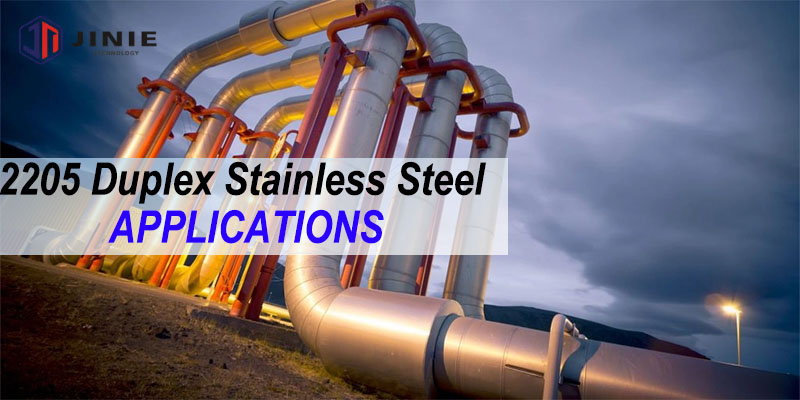
2205 is bought for five markets: oil and gas, chemical processing, marine and desalination, pollution control and FGD, and pressure-containing equipment such as vessels, tanks and heat exchangers. In every one of them the buying reason is the same - chlorides plus pressure.
In short, 2205 has many excellent properties and is a high-performance, multi-purpose stainless steel material. For any inquiry about 2205 stainless steel - pricing, availability or technical selection - contact JN directly.
Name the product standard on the order. Plate and sheet are ASTM A240, pipe is A790, tube is A789, flanges and forged fittings are A182 grades F51 and F60, bar is A276 or A479, and wrought butt-welding fittings are A815. Each has an ASME SA equivalent for coded pressure work.
| Product form | ASTM | ASME | Grade designation | JN page |
|---|---|---|---|---|
| Plate, sheet, strip | A240 / A240M | SA-240 | S31803, S32205 | duplex sheet and plate |
| Seamless and welded pipe | A790 / A790M | SA-790 | S31803, S32205 | duplex steel pipe |
| Seamless and welded tube | A789 / A789M | SA-789 | S31803, S32205 | ASTM A790 pipe guide |
| Flanges, forgings, forged fittings | A182 / A182M | SA-182 | F51, F60 | ASTM A182 S32205 flanges |
| Bar and shapes | A276 | SA-276 | S31803, S32205 | duplex round bars |
| Bar for pressure vessels | A479 | SA-479 | S31803, S32205 | duplex round bars |
| Wrought butt-welding fittings | A815 / A815M | SA-815 | WP-S31803, WP-S32205 | butt-welding pipe fittings |
| Intermetallic phase detection | A923 | - | All duplex grades | Acceptance test, not a product standard |
| Sour service qualification | NACE MR0175 / ISO 15156-3 | - | Solution annealed only | Name the edition on the order |
| European equivalent | EN 10088-3, EN 1.4462 | - | 1.4462 | about duplex S32205 |
| Certification | EN 10204 | - | 3.1 standard, 3.2 optional | Ask for 3.2 when third-party witness is required |
Product forms stocked and made to order include plate and sheet, seamless and welded pipe, tube, round bar, flanges to ASME B16.5, forged fittings, and butt-welding fittings such as elbows, tees and reducers - for example the S32205 short radius elbow. Cut-to-length plate, bevelling, polishing and export packing are available on the same order.
2205 costs more per kilogram than 316L and less than most super-austenitic and super duplex grades, and it is usually the cheapest option per unit of strength. The price you actually pay is driven by the alloy surcharges, the form and thickness, the certification package and the quantity.
| Driver | Direction of effect | How to control it |
|---|---|---|
| Nickel and molybdenum surcharges | The largest single variable; both are traded on the LME | Fix the surcharge basis and validity period in the quotation |
| Chromium and nitrogen content | Higher alloy means a higher melt cost | Do not over-specify S32205 where S31803 is adequate |
| Product form | Pipe and heavy plate cost more per kilogram than sheet and standard bar | Consolidate forms on one order where the schedule allows |
| Thickness and size | Thin sheet carries more rolling cost per kilogram; very heavy plate needs a larger ingot | Order to the standard size grid where possible |
| Quantity | Orders above roughly 10 tonnes normally earn a meaningful discount | Bundle line items into one release |
| Certification | EN 10204 3.2, NORSOK M-650, PED and third-party inspection all add cost | Specify 3.2 only where the code or the client requires it |
| Testing | ASTM A923, G48 pitting tests, Charpy at low temperature and PMI add per-heat or per-lot cost | Scope the tests to the actual risk |
| Processing | Cut-to-length, bevelling, polishing, machining and packing add handling cost | Ask whether the mill or the service centre is cheaper for the operation |
| Lead time | Rush orders under about three weeks carry a premium | Release the order against the mill's rolling programme |
The value argument for 2205 is not that it is cheap per kilogram. It is that a strength-governed vessel or pipe run needs roughly half the wall thickness of a 316L design, so less material, less weld metal, less weight and less freight can more than offset the higher unit price. Ask JN to price the same duty in 316L, 2205 and 2507 and compare the installed number, not the kilogram number.
Eight decisions remove almost every dispute: the UNS number, the standard and edition, the dimensions, the condition of supply, the corrosion acceptance criteria, the sour-service clause, the documentation package, and inspection plus Incoterms.
An eight-step checklist that removes the ambiguity that causes most 2205 order disputes.
Run five checks in order: the UNS number matches the drawing, every element is inside the ASTM band, the calculated PREN is where the specification promised, the solution-anneal temperature is 1040 degC or higher with a water quench, and the hardness is under the applicable maximum. Any single failure sends the certificate back to the mill.
| Check | What to look for | Fail action |
|---|---|---|
| 1. UNS number | S31803 or S32205, matching the drawing and the order | Reject - the two chemistries are not interchangeable in chloride duty |
| 2. Chemistry | Every element inside the ASTM A240 band for that UNS | Reject or request a concession with engineering sign-off |
| 3. Calculated PREN | Cr + 3.3Mo + 16N, at or above the value in the specification | Reject if the duty was chloride-driven |
| 4. Heat treatment | Solution annealed 1040 degC minimum, water quenched | Reject - the material may contain sigma phase |
| 5. Mechanical results | Yield at or above 450 MPa, elongation at or above 25 percent, hardness under 293 HBW or 31 HRC | Investigate; low elongation usually means cold work or a bad anneal |
| 6. Ferrite measurement | Typically 35 - 55 percent in the base metal, 30 - 70 percent in weld metal | Investigate if outside the band |
| 7. ASTM A923 | Pass the specified method - etch, Charpy or ferric chloride | Reject if specified and failed |
| 8. NACE MR0175 / ISO 15156-3 | Statement of compliance with the edition named on the order | Reject for sour service |
| 9. Traceability | Heat number on the certificate matches the number stamped on the material | Reject - no traceability means no certificate |
| 10. Signature | EN 10204 3.1 signed by the mill, or 3.2 countersigned by the third party | Reject an unsigned or photocopied document |
No. "2205" is the trade nickname for the whole family; S31803 and S32205 are two different UNS chemistries inside it. S32205 is the tighter, higher-alloy version: chromium 22.0-23.0 percent against 21.0-23.0 percent, molybdenum 3.0-3.5 percent against 2.5-3.5 percent, and nitrogen 0.14-0.20 percent against 0.08-0.20 percent. That tighter band raises the pitting resistance equivalent number, so S32205 is the safer buy for chloride and seawater duty. Always name the UNS number on the order.
Yes, you can weld them together, but always use ER2209 filler metal. Regular 316 filler will not work well because 2205 is stronger and more corrosion-resistant. The ER2209 filler creates a strong joint that balances both materials. Never weld them without filler metal, because an autogenous weld leaves a ferrite-rich, low-toughness bead that becomes a corrosion initiation site.
Weld 2205 with ER2209 or E2209 filler, keep heat input in the 0.5-2.5 kJ/mm band, hold interpass temperature at 150 degC (302 degF) or below, and back-purge with pure argon so the root does not oxidise. Control the temperature well and let the metal cool below 150 degC between passes. After welding, remove heat tint with pickling paste or a nitric-hydrofluoric acid bath and passivate. Do not apply post-weld heat treatment; if a thermal treatment is required the whole component must be re-solution-annealed.
Yes, 2205 duplex stainless steel is partly magnetic. This happens because about half of the microstructure is ferrite, which is ferromagnetic, while the austenite half is not. The magnetism is normal and does not mean the steel is low quality or will rust easily. It still performs very well in seawater and in chemical process duty.
PREN means pitting resistance equivalent number, calculated as PREN = percent chromium + 3.3 x percent molybdenum + 16 x percent nitrogen. As supplied, S31803 typically lands around 30-34 and S32205 around 34-36, against roughly 24-26 for 316L and 40 or more for super duplex 2507. It is a screening tool, not a certification value - ASTM A240 does not impose a minimum PREN - but asking for the calculated PREN on the mill test report is the cheapest way to prove that the heat you received is really seawater-grade duplex.
2205 is suitable for many seawater duties such as ballast and cargo tanks, firewater and cooling-water lines, heat exchanger shells and desalination balance-of-plant pipework, provided the water is flowing and not stagnant. For warm, stagnant or chlorinated seawater, or for creviced joints that cannot be inspected, step up to super duplex or a 6-molybdenum super-austenitic grade.
In practice continuous service is capped at about 300 degC (572 degF), and design codes often stop at 250-300 degC. Above roughly 300 degC long-term exposure causes 475 degC embrittlement, and between about 600 degC and 900 degC (1110-1650 degF) sigma and chi intermetallic phases precipitate and destroy both toughness and corrosion resistance. Below the freezing end, 2205 stays tough to about -50 degC (-58 degF) with 100 J or better Charpy energy, but it is not a cryogenic alloy - use austenitic grades below that.
Solution-annealed S31803 and S32205 are listed in NACE MR0175 / ISO 15156-3 for sour (H2S-containing) service subject to the hardness and environmental limits of the edition in force. The practical consequences are: order in the solution-annealed condition only, require hardness well under the ASTM A240 maximum of 31 HRC, and name the exact edition of MR0175 or ISO 15156-3 on the purchase order so that there is no argument later.
No. Duplex 2205 welds are used in the as-welded condition; post-weld heat treatment is not applied because reheating into the 600-900 degC range precipitates sigma phase. If a stress relief is unavoidable on code grounds, the only safe route is a full re-solution anneal at 1040 degC (1900 degF) minimum followed by a water quench, which means treating the whole fabrication, not just the weld.
2205 roughly doubles the allowable design strength: 450 MPa minimum yield against about 170 MPa for 316L. That lets you cut plate thickness by roughly 30 to 50 percent on a strength-governed vessel, which cuts weld metal, weight, lifting cost and often total cost, even though 2205 costs more per kilogram. It also removes the chloride stress corrosion cracking risk that limits 316L to about 50 degC in chloride-bearing water.
Upgrade when the chloride load, the temperature or the stagnation risk exceeds what a PREN of about 35 can carry: warm seawater above roughly 30 to 40 degC, concentrated brines, aerated acidic chloride, or any crevice that cannot be inspected or flushed. Super duplex 2507 (UNS S32750, F53) carries a PREN around 40-42 and a 550 MPa minimum yield, so it also buys extra strength.
Yes to both. Hot form between 1750 degF and 2250 degF (955-1230 degC) with the whole workpiece heated, then solution anneal at 1900 degF (1040 degC) minimum and water quench to restore phase balance. Cold forming is possible but 2205 needs higher forming loads than 316L because of its yield strength, and springback is roughly two to three times that of austenitic grades, so allow extra overbend and use a larger bend radius.
Per kilogram, yes - 2205 usually carries a noticeable premium over 316L because of the higher chromium, molybdenum and nitrogen content and the tighter melt control. Per unit of strength it is usually cheaper, because you buy roughly half the thickness for the same design load. The break-even normally arrives as soon as wall thickness is strength-governed rather than corrosion-governed.
Ask for an EN 10204 3.1 mill test certificate as the minimum, or 3.2 when a third party (SGS, BV, TUV, DNV, Lloyd's) must witness. The certificate should show the UNS number, the heat number, the full chemical analysis, the calculated PREN, the mechanical test results, the solution-anneal temperature, the ferrite count, intergranular corrosion test results to ASTM A923 when specified, and the NACE MR0175 / ISO 15156-3 statement if the duty is sour.
Lean duplex grades such as UNS S32101 (2101) and UNS S32304 (2304) cut nickel and molybdenum to reduce cost and price volatility. They still beat 316L on yield strength, but their PREN sits around 25-30, below the 34-36 of 2205, so they are a strength-and-cost play for mild environments rather than a corrosion upgrade. Use 2205 when chlorides are the reason you are leaving 316L behind.
2205 resists rust far better than 316L, but it is stainless, not stain-free. It will discolour or pit if heat tint from welding is left on the surface, if free iron from carbon steel tooling is embedded in it, or if it sits under a stagnant chloride deposit. Removing heat tint by pickling, passivating after fabrication and keeping the surface free of iron contamination prevents almost every real-world rust complaint.
Use ER2209 bare wire for GTAW and GMAW, E2209-16 or E2209-17 covered electrodes for SMAW, and a 2209 flux-wire combination for submerged arc. The ISO designation is 22 9 3 N L. The filler is deliberately over-alloyed in nickel - around 9 percent against 5-6 percent in the base metal - so that the weld metal re-balances to roughly equal ferrite and austenite as it cools.
JN supplies duplex 2205 as plate and sheet to ASTM A240, seamless and welded pipe to ASTM A790, tube to ASTM A789, round bar to ASTM A276 and A479, forgings, flanges and forged fittings to ASTM A182 grade F51 and F60, and wrought butt-welding fittings to ASTM A815. Cut-to-length plate, bevelling, third-party inspection and export packing are available on the same order.
Work through five checks in order. First, does the UNS number match the one on the drawing? Second, is every element inside the ASTM A240 band for that UNS? Third, what is the calculated PREN, and is it where the specification said it would be? Fourth, is the solution-anneal temperature at 1040 degC minimum with a water quench? Fifth, is the hardness under the maximum and, for sour service, under the NACE limit? A certificate that fails any one of the five should go back to the mill.
Lead time depends on form and quantity. Common sizes of 2205 plate, pipe and bar are normally held or sourced within one to three weeks, while large-diameter pipe, heavy plate, forged flanges and made-to-order fittings typically run four to eight weeks including solution annealing, testing and packing. Send the UNS number, form, dimensions, quantity, standard and destination port and JN will confirm a firm ex-works or FOB date.


