
Views: 4 Author: Monica Publish Time: 2025-12-31 Origin: Site


ASME B16.49 is a standard developed by the American Society of Mechanical Engineers (ASME) that specifies requirements for factory-made, wrought steel buttwelding induction bends.
These bends are curved sections of pipe produced through an induction heating process, designed to change the direction of fluid flow in pipelines. They are commonly used in applications such as oil and gas transportation, where durability under high pressure and temperature is essential.
The latest edition of the standard is ASME B16.49-2023, which has been placed under stabilized maintenance to reflect its mature status with minimal expected changes.
ASME B16.49 includes carbon steel materials with controlled chemical composition and mechanical properties to ensure consistency and performance. Key chemicals include:
Element | Symbol | Maximum, % |
Carbon | C | 0.30 |
Manganese | Mn | 1.60 [Note (1)] |
Phosphorus | P | 0.025 |
Sulfur | S | 0.015 |
Silicon | Si | 0.50 |
Chromium | Cr | 0.30 |
Molybdenum | Mo | 0.25 |
Vanadium | V | 0.10 |
Copper | Cu | 0.50 |
Nickel | Ni | 1.00 |
Niobium | Nb (Cb) | 0.10 |
GENERAL NOTE:
The chemical requirements of this table are not intended to represent the composition of any heat of steel but to record the maximum permissible amounts of individual elements.
NOTE:
(1) For Grades P483 (X483) and higher for each reduction of 0.01% below the specified maximum carbon content, an increase of 0.05% above the maximum manganese content is permissible, up to a maximum of 2.00%.
Mechanical grades range from P241 (yield strength 35 ksi / 241 MPa) to P552 (yield strength 80 ksi / 552 MPa), each with specified tensile strength, elongation, hardness, and impact toughness requirements.
Bends can be made from seamless or welded pipes, but the standard does not extend to stainless steels or nickel alloys, which are typically addressed in other standards like ASME B16.9 for general buttweld fittings.
ASME B16.49:2023 establishes comprehensive requirements for factory-made pipeline bends manufactured using induction bending processes.
This standard is particularly relevant for pipeline systems that require custom bend angles and radii that cannot be achieved with standard factory-made fittings. Induction bending offers advantages in terms of structural integrity and flow characteristics compared to traditional segmented bending methods.

Grade (Symbol) | Minimum Tensile Properties | Maximum Hardness | |||
Yield Strength,MPa (ksi) | Tensile Strength, MPa (ksi) | Elongation, % | HBW[Note (1)] | HRC[Note (2)] | |
P241 (X241) | 241 (35) | 414 (60) | 20 | 238 | 22 |
P290 (X290) | 290 (42) | 414 (60) | 20 | 238 | 22 |
P317 (X317) | 317 (46) | 434 (63) | 20 | 238 | 22 |
P359 (X359) | 359 (52) | 455 (66) | 20 | 238 | 22 |
P386 (X386) | 386 (56) | 490 (71) | 20 | 238 | 22 |
P414 (X414) | 414 (60) | 517 (75) | 20 | 238 | 22 |
P448 (X448) | 448 (65) | 531 (77) | 18 | 238 | 22 |
P483 (X483) | 483 (70) | 565 (82) | 16 | 247 | 24 |
P552 (X552) | 552 (80) | 621 (90) | 16 | 247 | 24 |
GENERAL NOTE: Intermediate grades may be purchased subject to agreement between the purchaser and manufacturer.
NOTES:
(1) HBW (Hardness Brinell) is the primary number.
(2) HRC (Hardness Rockwell C) is an approximation based on ASTM E140 hardness conversion.
ASME B16.49 Carbon Steel Pipe Bend Grades
- ASTM A234 WPB
- ASTM A420 WPL3 WPL6 (low-temperature service)
- Applications: Suitable for general service conditions, including oil, gas, and water pipelines, where toughness and strength are required.
- ASTM A234 WP11, WP22, WP9, WP91
- ASTM A860 WPHY 42, WPHY 46, WPHY 52, WPHY 60, WPHY 65, WPHY 70 (high-yield-strength materials)
- Applications: Used in high-temperature and high-pressure environments, such as power plants, refineries, and chemical plants.
- ASTM A403 WP304, WP304L, WP316, WP316L, WP321, WP347
- Applications: Ideal for corrosive environments, including food processing, pharmaceuticals, and chemical industries.
ASME B16.49 Duplex Stainless Steel Pipe Bend Grades
- ASTM A815 UNS S31803 (Duplex 2205)
- ASTM A815 UNS S32750 (Super Duplex 2507)
- Applications: Provides higher strength and corrosion resistance; used in oil and gas, marine, and chemical processing industries.
- ASTM B366 UNS N06600 (Inconel 600), UNS N06625 (Inconel 625), UNS N08825 (Incoloy 825)
- ASTM B366 UNS N10276 (Hastelloy C276)
- ASTM B366 UNS N04400 (Monel 400)
- ASTM B366 UNS N06022 (Hastelloy C22)
- Applications: Used in applications requiring specific resistance to certain chemicals or environments, such as sulfuric acid plants, chemical processing, and pollution control equipment.
Induction bends manufactured to ASME B16.49 can be made from either seamless or welded pipes with or without tangent length by a cold- or heat-forming process. Generally, the ASME B16.49 nickel alloy pipe bend heat-forming process is applied, which utilizes the mid-frequency induction-bending machine.

This process utilizes induction heating to heat a narrow band 360 deg around a pipe or cylinder at the point of bending as the pipe or cylinder is being pushed through the inductor coil at a constant velocity.
After the material passes through the coil, it may be cooled by forced air or water spray, or it may be allowed to cool in still air. Bends in any producible wall thickness and diameter are covered.
Control Link | Control Points | Specific Requirements |
Induction Heating & Bending | Heating Temperature | 850±50°C (adjustable by material, e.g., 830~880°C for X65 steel) |
Heating Width | ≥2D for 3D bends. ≥3D for 5D bends. ≥4D for 7D bends | |
Bending Speed | 5°~10°/min for 3D bends. 10°~15°/min for 5D~7D bends (with real-time angle monitoring) | |
Heat Treatment Control | Inspection Requirements | Measure angle, radius, and ovality before and after heat treatment |
Over-tolerance Handling | Cold straightening allowed (deformation ≤ 0.5% for carbon steel) |
ASME B16.49 specifications ensure bends match the pressure ratings and dimensions of connecting pipes. Sizes are flexible, covering any producible diameter and wall thickness, often specified by schedule (e.g., SCH40 or SCH80).
Bend Angles: Common angles include 30°, 45°, 60°, and 90°.
Bend Radii: Designated as multiples of the nominal diameter (e.g., 3D, 5D), where "D" is the pipe's outside diameter. For a 6-inch pipe with a 5D radius, the centerline radius is 30 inches.
Ends: Beveled per ASME B16.25 for welding.
Pressure ratings align with the pipe's schedule, though they are not explicitly tabulated in the standard.

Angle range
ASME B16.49 covers bend radii of 2D to 10D and angles of 15° to 135° and allows customization. ASME B16.9 mainly focuses on 1.5D long radius elbows, with angles concentrated at 45°, 90°, and 180°, and does not support customization of large radii (≥5D). ASME B16.28 is only for 1.0D short radius elbows, with angles limited to 45° and 90°, and no customization space.
Tolerance control perspective
The angular tolerance (±1.5°) of ASME B16.49 is consistent with ASME B16.9, but the bending radius tolerance (±1.5%) is stricter than that of ASME B16.9 (±2%) and ASME B16.28 (±2.5%).
Regarding ellipticity requirements, the bending section (≤2.5%) of ASME B16.49 is slightly wider than that of ASME B16.9 (≤2%), but the weld end (≤1%) is consistent with both.
Geometric compatibility perspective
The large radius (5D, 7D) bends of ASME B16.49 are suitable for high-velocity (≥3 m/s) fluid transport, reducing fluid resistance; the 1.5D bends of ASME B16.9 are suitable for conventional process piping, balancing space and resistance; and the 1.0D bends of ASME B16.28 are only suitable for scenarios with extremely limited space, requiring acceptance of higher fluid resistance losses.
Comparative Standard | Core Differences of B16.49 |
ASME B16.9 | 1. Supports large radii (2D~10D) + custom angles. 2. Tighter radius tolerance (±1.5%); 3. Suitable for high-flow-rate scenarios |
ASME B16.28 | 1. ASME B16.28 only covers short radii (1.0D) and fixed angles (45°/90°). 2. ASME B16.49 has better spatial adaptability |
ASME B16.49 Pressure Rating
Pressure-Temperature Ratings: Pipe elbows must withstand the pressure ratings specified by the connected piping system, ensuring that the elbow's pressure rating matches the same rating as the pipe.
- ASME B16.49 Pressure ratings are based on the class of pipe, material, and wall thickness.
- Wall Thickness and Pressure Relationship: For a given NPS, the elbow's wall thickness must meet the design pressure requirements at the specified operating temperature.
ASME B16.49 Specification Marking
The marking requirements ensure traceability and compliance with the standard:
- Manufacturer's Identification: Includes the manufacturer’s name or trademark.
- Material Grade: Denotes the steel grade or material type.
- Pipe Size and Radius: Includes the nominal pipe size, bend radius, and wall thickness.
- Pressure Rating: Specifies the pressure class or schedule of the pipe elbow.
- ASME B16.49 Standard Designation: Marking the part as per ASME B16.49, ensuring compliance with the specification.
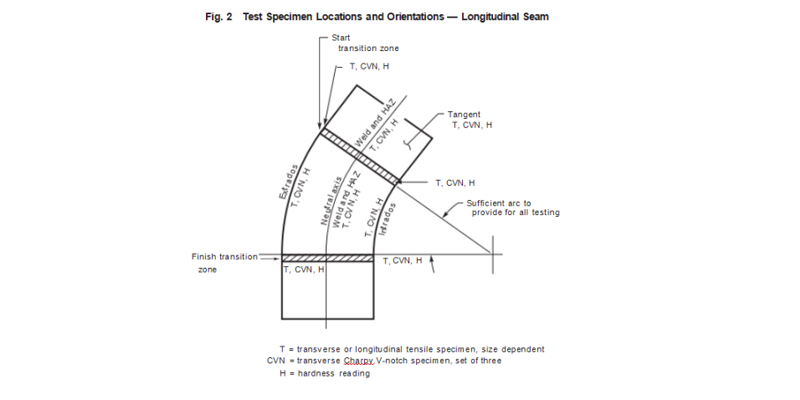

Testing Requirements
ASME B16.49 Pipe Bend Normalizing. Heat above the transformation temperature range and hold at temperature for a minimum of 20 min per 25 mm (1 in.) of thickness, but not less than 20 min, and allow to cool in still air.
ASME B16.49 Pipe elbows must undergo various testing procedures to verify their compliance with the standard:
Non-Destructive Testing (NDT): Includes methods such as
- ASME B16.49 SS Pipe Bend Ultrasonic Testing (UT) or Radiographic Testing (RT) to detect internal flaws.
- Magnetic Particle Inspection (MPI) or Dye Penetrant Testing (DPT) to detect surface cracks or imperfections.
- Hydrostatic Testing: A pressure test is performed to ensure the elbow can withstand specified internal pressures without failure or leaks. The test pressure is usually 1.5 times the design pressure of the system.
- ASME B16.49 CS Pipe Bend Dimensional Inspection: A detailed dimensional inspection is performed to verify that the bend radius, wall thickness, and end dimensions meet the tolerance requirements.
ASME B16.49 governs the manufacturing, testing, and quality assurance of factory-made wrought steel pipe elbows for high-pressure systems.
ASME B16.49 Pipe Bend Specification ensures that pipe elbows maintain appropriate tolerances, material strength, and pressure ratings and undergo thorough testing to guarantee integrity in service. This helps to provide consistent performance in high-pressure environments like oil and gas pipelines, chemical processing, and other critical industries.


