
Views: 10 Author: Monica Publish Time: 2026-03-02 Origin: Site


A blind flange is a solid, bolt-on disk that seals the end of a pipe, valve, or vessel with no bore - the simplest and most reliable way to isolate, terminate, test, or provide future access to a piping system. This 2026 guide covers ASME B16.5 dimensions and weights (Class 150 to 2500), the main blind-flange types, how thickness is calculated, how to select the right material and class, and a comparison table to help you specify the correct blind flange.
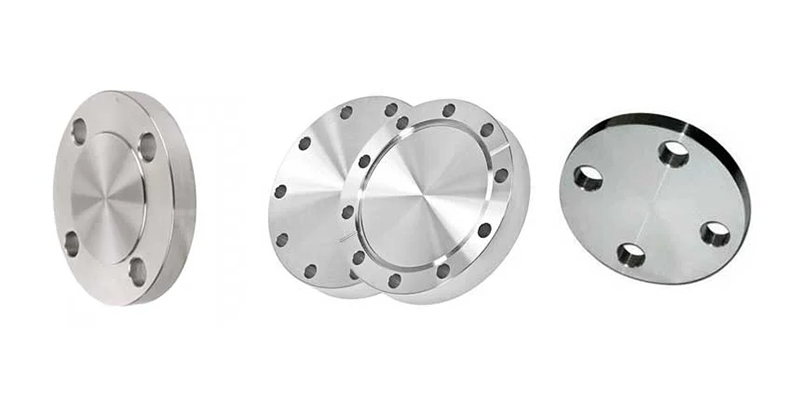
Blind flange is a solid disk with the same bolt pattern and sealing face as a standard flange, used to bolt directly onto a mating flange to close off a line permanently or temporarily.
It is manufactured with no opening, providing positive isolation of the pipeline. Machined with the same bolt circle and raised-face dimensions as standard flanges, it bolts directly to another flange to close a line. Sealing faces come in several configurations - flat face (FF), raised face (RF), ring-type joint (RTJ), and tongue-and-groove - to match different gaskets and pressure requirements.
Blind flange dimensions for NPS 1/2 to 24 are governed by ASME B16.5 (larger sizes by ASME B16.47); the tables below give the standard outside diameter, thickness, bolt circle, bolt holes, and approximate weight per pressure class.
Class 150 flanges are suitable for general service applications with lower pressure requirements. The following table provides complete dimensions for blind flanges according to ASME B16.5.
Nominal Pipe Size (NPS) | Outside Diameter (in) | Flange Thickness (in) | Raised Face Diameter (in) | Number of Bolt Holes | Bolt Hole Diameter (in) | Bolt Circle Diameter (in) | Approx. Weight (lbs) |
1/2 | 3.5 | 0.44 | 1.38 | 4 | 0.62 | 2.38 | 2 |
3/4 | 3.88 | 0.5 | 1.69 | 4 | 0.62 | 2.75 | 2 |
1 | 4.25 | 0.56 | 2.0 | 4 | 0.62 | 3.12 | 2 |
1 1/4 | 4.62 | 0.62 | 2.5 | 4 | 0.62 | 3.5 | 3 |
1 1/2 | 5.0 | 0.69 | 2.88 | 4 | 0.62 | 3.88 | 3 |
2 | 6.0 | 0.75 | 3.62 | 4 | 0.75 | 4.75 | 4 |
2 1/2 | 7.0 | 0.88 | 4.12 | 4 | 0.75 | 5.5 | 7 |
3 | 7.5 | 0.94 | 5.0 | 4 | 0.75 | 6.0 | 9 |
3 1/2 | 8.5 | 0.94 | 5.5 | 8 | 0.75 | 7.0 | 13 |
4 | 9.0 | 0.94 | 6.19 | 8 | 0.75 | 7.5 | 17 |
5 | 10.0 | 0.94 | 7.31 | 8 | 0.88 | 8.5 | 20 |
6 | 11.0 | 1.0 | 8.5 | 8 | 0.88 | 9.5 | 27 |
8 | 13.5 | 1.12 | 10.62 | 8 | 0.88 | 11.75 | 47 |
10 | 16.0 | 1.19 | 12.75 | 12 | 1.0 | 14.25 | 67 |
12 | 19.0 | 1.25 | 15.0 | 12 | 1.0 | 17.0 | 123 |
14 | 21.0 | 1.38 | 16.25 | 12 | 1.12 | 18.75 | 139 |
16 | 23.5 | 1.44 | 18.5 | 16 | 1.12 | 21.25 | 187 |
18 | 25.0 | 1.56 | 21.0 | 16 | 1.25 | 22.75 | 217 |
20 | 27.5 | 1.69 | 23.0 | 20 | 1.25 | 25.0 | 283 |
24 | 32.0 | 1.88 | 27.25 | 20 | 1.38 | 29.5 | 415 |
For higher pressure applications, Class 300 flanges are required. They feature thicker walls and different bolt patterns compared to Class 150.
Nominal Pipe Size (NPS) | Outside Diameter (in) | Flange Thickness (in) | Raised Face Diameter (in) | Number of Bolt Holes | Bolt Hole Diameter (in) | Bolt Circle Diameter (in) | Approx. Weight (lbs) |
1/2 | 3.75 | 0.56 | 1.38 | 4 | 0.63 | 2.62 | 2 |
3/4 | 4.62 | 0.63 | 1.69 | 4 | 0.75 | 3.25 | 3 |
1 | 4.88 | 0.69 | 2.00 | 4 | 0.75 | 3.50 | 3 |
1 1/4 | 5.25 | 0.75 | 2.50 | 4 | 0.75 | 3.88 | 4 |
1 1/2 | 6.13 | 0.81 | 2.88 | 4 | 0.88 | 4.50 | 6 |
2 | 6.50 | 0.88 | 3.63 | 8 | 0.75 | 5.00 | 8 |
2 1/2 | 7.50 | 1.00 | 4.13 | 8 | 0.88 | 5.88 | 12 |
3 | 8.25 | 1.13 | 5.00 | 8 | 0.88 | 6.63 | 16 |
3 1/2 | 9.00 | 1.19 | 5.50 | 8 | 0.88 | 7.25 | 21 |
4 | 10.00 | 1.25 | 6.19 | 8 | 0.88 | 7.88 | 27 |
5 | 11.00 | 1.38 | 7.31 | 8 | 0.88 | 9.25 | 35 |
6 | 12.50 | 1.44 | 8.50 | 12 | 0.88 | 10.63 | 50 |
8 | 15.00 | 1.63 | 10.63 | 12 | 1.00 | 13.00 | 81 |
10 | 17.50 | 1.88 | 12.75 | 16 | 1.13 | 15.25 | 124 |
12 | 20.50 | 2.00 | 15.00 | 16 | 1.25 | 17.75 | 185 |
14 | 23.00 | 2.13 | 16.25 | 20 | 1.25 | 20.25 | 250 |
16 | 25.50 | 2.25 | 18.50 | 20 | 1.38 | 22.50 | 295 |
18 | 28.00 | 2.38 | 21.00 | 24 | 1.38 | 24.75 | 395 |
20 | 30.50 | 2.50 | 23.00 | 24 | 1.38 | 27.00 | 505 |
24 | 36.00 | 2.75 | 27.25 | 24 | 1.63 | 32.00 | 790 |
Higher pressure classes (400, 600, 900, 1500, 2500) have significantly larger dimensions and thicker walls.
Class | NPS | Outside Diameter (in) | Thickness (in) | Bolt Circle (in) | Number of Holes | Hole Diameter (in) |
400 | 4 | 10.0 | 1.19 | 7.88 | 8 | 0.88 |
6 | 12.5 | 1.44 | 10.63 | 12 | 0.88 | |
8 | 15.0 | 1.63 | 13.0 | 12 | 1.0 | |
12 | 20.5 | 2.0 | 17.75 | 16 | 1.25 | |
600 | 4 | 10.75 | 1.5 | 8.5 | 8 | 0.88 |
6 | 14.0 | 1.56 | 11.5 | 12 | 0.88 | |
8 | 16.5 | 1.88 | 13.75 | 12 | 1.0 | |
12 | 22.0 | 2.38 | 19.25 | 20 | 1.25 | |
900 | 4 | 12.0 | 1.75 | 9.5 | 8 | 1.0 |
6 | 15.5 | 2.19 | 12.5 | 12 | 1.12 | |
8 | 18.5 | 2.5 | 15.5 | 12 | 1.25 | |
12 | 24.0 | 3.13 | 21.0 | 20 | 1.38 | |
1500 | 4 | 12.25 | 2.5 | 9.5 | 8 | 1.12 |
6 | 15.5 | 3.25 | 12.5 | 12 | 1.38 | |
8 | 19.0 | 3.63 | 15.5 | 12 | 1.62 | |
12 | 28.0 | 4.63 | 23.0 | 16 | 2.12 | |
2500 | 4 | 14.0 | 3.63 | 10.75 | 8 | 1.38 |
6 | 19.0 | 5.0 | 15.0 | 8 | 1.88 | |
8 | 21.5 | 5.75 | 17.25 | 12 | 2.0 | |
12 | 30.0 | 7.5 | 25.0 | 12 | 2.62 |
Note: For NPS 26-60, use ASME B16.47 (Series A / Series B). Dimensions above are per ASME B16.5 and may vary slightly by manufacturer.
Blind flanges are selected by face type (RF, FF, RTJ) and by configuration (standard, spectacle/figure-8, butt-weld hub) - the choice depends on pressure class, the mating equipment, and whether you need frequent open/close isolation.
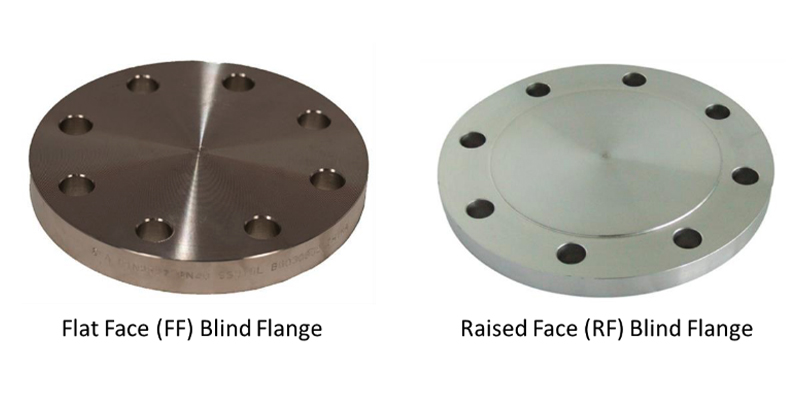
Standard Raised Face (RF) Blind Flange
The most common type: a raised sealing ring concentrates gasket compression for a tight seal. RF height is typically 1/16 in for Class 150/300 and 1/4 in for Class 600 and above. Suitable for a wide pressure/temperature range with spiral-wound, ring-joint, or soft gaskets.
Flat Face (FF) Blind Flange
A fully flat sealing surface used with flat-faced mating flanges and soft full-face gaskets, mainly in low-pressure water, HVAC, and fire-protection service. The full contact area spreads bolt load and protects brittle (e.g., cast iron) equipment from bending stress.
Ring-Type Joint (RTJ) Blind Flange
A machined groove accepts a metal ring gasket for a metal-to-metal seal. Used in Class 600+ oilfield, refinery, and high-pressure chemical service where leak integrity must survive temperature swings.
Figure-8 / Spectacle Blind Flange
A combination unit with one solid (blind) disk and one matching spacer disk joined by a web. Rotating it switches the line between closed and open without separate parts - ideal for filter banks, parallel pumps, and maintenance bypass.
Butt Weld (Hub) Blind Flange
A blind flange with a tapered hub welded to the pipe, minimizing weld stress concentration. Less common, but used for cyclic loading, severe service, and extreme temperature where a full-penetration weld is required.
Beyond simply sealing a line, blind flanges provide system termination, maintenance access, hydrotest isolation, and future-expansion tie-ins.
System termination: a safe, pressure-rated end to a piping system.
Maintenance access: unbolting gives entry for cleaning, inspection, or repair without cutting/welding.
Pressure testing: seals sections so hydrotests can verify weld and joint integrity.
Future expansion: a tee with a blind lets a future connection be made by simply removing the blind.
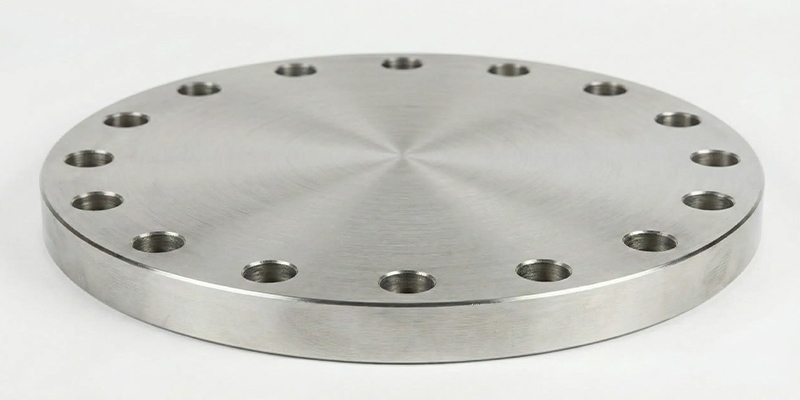
Weight scales with outside diameter, thickness, and material density; the table below gives typical stainless-steel (ASTM A182, ~7.90-8.03 g/cm3) weights for ASME B16.5 Class 150 blind flanges.
Nominal Pipe Size (inches) | Outside Diameter (mm) | Thickness (mm) | Weight (kg) - Stainless Steel |
1/2 | 90 | 11.2 | 0.9 |
3/4 | 100 | 12.7 | 1.2 |
1 | 110 | 14.2 | 1.5 |
1¼ | 115 | 15.7 | 1.9 |
1½ | 125 | 17.5 | 2.3 |
2 | 150 | 19.1 | 3.2 |
2½ | 180 | 22.4 | 5.0 |
3 | 190 | 23.9 | 6.5 |
4 | 230 | 23.9 | 9.5 |
6 | 280 | 25.4 | 17.0 |
8 | 345 | 28.4 | 29.0 |
10 | 405 | 30.2 | 42.0 |
12 | 485 | 31.8 | 68.0 |
14 | 535 | 35.1 | 86.0 |
16 | 595 | 36.6 | 116.0 |
18 | 635 | 39.6 | 145.0 |
20 | 700 | 42.9 | 185.0 |
24 | 815 | 47.8 | 270.0 |
Blind flange weight equals volume x material density; a quick industry estimate is Weight (kg) = (OD^2 x 6.17 x T) / 1,000,000 (OD and T in mm), and a precise method subtracts bolt-hole volume from the solid disk volume.
Solid disk volume = π x (OD/2)^2 x T
Bolt-hole volume = N x π x (hole dia/2)^2 x T
Net volume = solid - bolt holes; Weight = net volume x density
Material densities: carbon steel 7.85 g/cm3; stainless 304/316 7.90-8.03 g/cm3; nickel alloys 8.4-8.9 g/cm3.
Example: a 24 in Class 150 stainless blind (OD 815 mm, T 47.8 mm): solid volume ≈ 24.92 x 10^6 mm3; subtracting 20 x 35 mm bolt holes (≈ 0.92 x 10^6 mm3) gives ~24.0 x 10^6 mm3 = 24,000 cm3 x 7.90 g/cm3 ≈ 190 kg, close to the table value (bolt-hole deduction explains the small difference).
Blind flange thickness is calculated as a bolted flat cover per ASME VIII / B16.5 rules:
t = d x sqrt( (C x P) / (S x E) + (1.9 x W x h_g) / (S x E x d^3) )
where d = inside diameter (or short span), C = 0.3 for bolted flat covers, P = design pressure, S = allowable stress, E = joint efficiency (typically 1), W = bolt load, and h_g = gasket moment arm. For procurement, use the tabulated ASME B16.5 thickness rather than calculating by hand.
Pick the blind flange type by pressure class, the mating equipment, and whether you need frequent open/close isolation; the tables below compare configuration choices and blind flanges against alternative closure methods.
Table A: Blind Flange Type Selection
| Type | Seal / Feature | Typical Class | Select When |
|---|---|---|---|
| RF Blind | Raised face + soft/spirral gasket | 150-2500 | General process service (most common) |
| FF Blind | Flat face + full-face gasket | 150-300 | Bolting to cast iron / brittle equipment |
| RTJ Blind | Metal ring, metal-to-metal | 600+ | High-pressure gas, oilfield, volatile service |
| Spectacle / Figure-8 | Blind + spacer in one unit | 150-600 | Frequent open/close isolation (bypass, filters) |
| Butt-Weld Hub Blind | Full-penetration weld to pipe | Any | Cyclic load, severe/extreme-temperature service |
Table B: Blind Flange vs Alternative Closure Methods
| Method | Reusability | Effort to Open | Pressure Rating | Best Use |
|---|---|---|---|---|
| Blind flange | Reusable | Unbolt (minutes) | Full ASME class | Permanent/temporary line closure, testing, access |
| Cap / pipe cap | Not reusable | Cut off | Full (welded) | Permanent pipe end, no future access |
| Spectacle blind | Reusable | Rotate (minutes) | Full ASME class | Frequent isolation / changeover |
| Block valve | Reusable | Turn handle | Full (valve rated) | Operational on/off control, not isolation proof |
Blind flanges are ubiquitous in industries where fluid or gas transport is central to operations.
Oil and Gas Industry: Used to seal off high-pressure wellheads and manifold systems. In these environments, duplex stainless steel or Nickel Alloy 625 is often preferred for its resistance to sour gas and chloride stress corrosion cracking.
Chemical Processing: Blind flanges act as "manways" on chemical reactors and storage tanks, allowing for periodic internal cleaning and vessel entry.
Water Treatment: Used in large-scale desalination and filtration plants to manage the flow of seawater and treated water.
Power Generation: In steam lines and cooling systems, blind flanges provide the necessary isolation points for safety.
1. What is a blind flange used for?
A blind flange seals the end of a pipe, valve, or vessel with no bore. It is used for system termination, maintenance access, hydrostatic pressure testing, and future-expansion tie-ins, providing reliable positive isolation.
2. How do I calculate blind flange thickness?
Blind flange thickness is calculated as a bolted flat cover: t = d x sqrt( (C x P)/(S x E) + (1.9 x W x h_g)/(S x E x d^3) ), where d is the inside diameter, C = 0.3, P is design pressure, S is allowable stress, E is joint efficiency, W is bolt load, and h_g is the gasket moment arm. In practice, use the tabulated ASME B16.5 thickness for the ordered class and size.
3. Do blind flanges require hydrotesting?
Flanges manufactured to ASME B16.5 are not individually hydrotested by the standard; the material and dimensions are verified by the MTR. Hydrotesting is performed on the assembled piping system or vessel, where the blind flange serves as the closure that makes the test possible.
4. What standard covers blind flange dimensions?
Blind flange dimensions for NPS 1/2-24 follow ASME B16.5; NPS 26-60 follow ASME B16.47 (Series A/B). Material and marking for forged stainless/duplex/nickel blind flanges follow ASTM A182 (and related ASTM product specs).
5. How do I select the right blind flange material?
Match the flange material to the line: 316L/304L for general corrosion, duplex 2205 (F51/F60) or super duplex 2507 (F53/F55) for chloride and seawater, and nickel alloys (Inconel 625, Hastelloy C276, Incoloy 825) for severe acid or high-temperature service. Always require an MTR and PMI verification.
6. Blind flange vs spectacle blind: which should I choose?
Choose a standard blind flange for simple, infrequent closure or testing. Choose a spectacle (figure-8) blind when the line must be opened and closed repeatedly - rotating the unit switches between blind and open spacer without separate parts, ideal for bypass lines and maintenance changeover.
A blind flange is the most dependable way to close, isolate, test, or provide access to a piping system. Specify it by ASME B16.5 dimensions and class, choose the face type (RF/FF/RTJ) and configuration (standard or spectacle) for your service, and select the material to match the line's corrosion demands.
Need blind flanges or spectacle blinds? JN Alloy stocks blind flanges in stainless steel (304/316/316L/904L/254SMO), duplex (2205/S31803/S32205), super duplex (2507/S32760), and nickel alloys (Inconel, Incoloy, Hastelloy, Monel) with full material test certificates and custom machining. Contact our engineers: Info@jnalloy.com | +86-193-3990-0211 | www.jnalloy.com.


