
Views: 58 Author: Monica Publish Time: 2025-10-20 Origin: Site


Stainless steel pipes play a key role in petrochemical plants, aerospace systems, semiconductor factories, food processing lines, and medical equipment. They resist corrosion, provide high strength, and last for decades. Their secret is a thin, protective chromium oxide layer that forms naturally on the surface when the steel contains at least 10.5% chromium. This layer acts like a shield against rust and damage.
Experts divide stainless steel pipe production into two main types: seamless pipes and welded pipes. Each type follows exact steps to meet strict standards such as ASTM A312. Seamless pipes handle high pressure and high temperature best. Welded pipes cost less and work well for everyday fluid transport and structural uses. Here is a clear, step-by-step guide to how manufacturers make these steel pipes.
The making process of stainless steel pipes is divided into two types: seamless pipe manufacturing and welded pipe manufacturing, which differ in raw materials and forming methods.
Seamless pipes start as solid round steel billets. They go through the following steps:
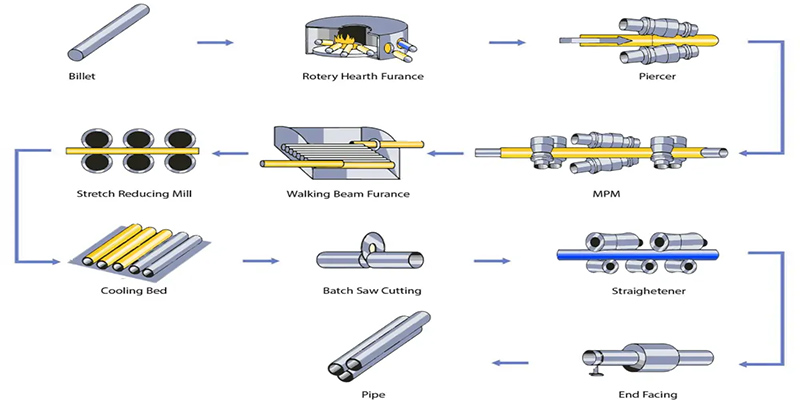
Step 1: Raw Material Preparation & Heating
We select high-quality round steel billets that meet strict chemical composition requirements, such as grades 304 and 316L. The billets are inspected and cleaned to remove surface defects.
They are then heated in a furnace to reach the right temperature for shaping.
For different steel grades, the heating temperature is controlled between 850°C and 1200°C to make the billet soft and ready for piercing.
Step 2: Piercing
This is the key step that makes a seamless pipe different from a welded one. The heated billet is fed into a piercing mill. Two angled rolls push the billet forward while rotating. A mandrel pierces through the center, turning the solid billet into a hollow tube.
The roll speed and mandrel position must be carefully controlled to avoid uneven wall thickness or internal cracks.
Step 3: Hot Rolling & Elongation
The hollow tube goes through a rolling mill. Multiple sets of rollers and an internal mandrel work together to reduce the outer diameter and wall thickness. This process also improves the internal structure of the steel.
Step 4: Sizing & Reducing
The tube passes through sizing and reducing mills to get its final outer diameter and roundness. This step ensures the pipe meets the required dimensions.
Precision target: Outer diameter error is controlled to ≤ ±0.1 mm.
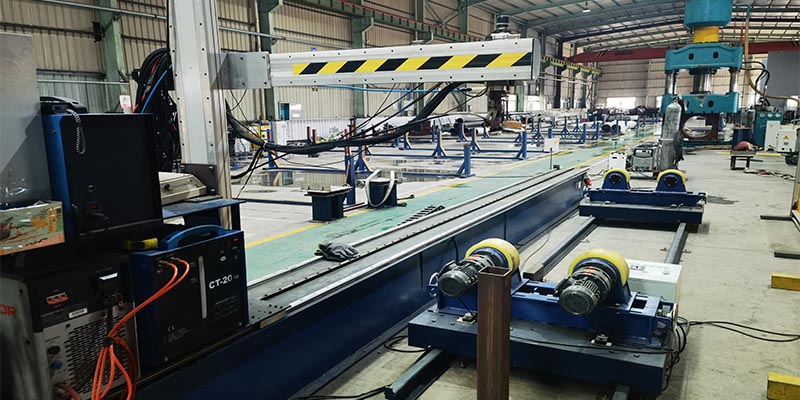
Step 5: Cold Drawing or Cold Rolling
For pipes that need very high dimensional accuracy, thin walls, or a smooth surface, cold working is used.
Cold drawing: Pulling the tube through a die smaller than its diameter
Cold rolling: Using rollers to press and shape the tube
How much reduction: Each cold rolling pass reduces the diameter and wall thickness by 10% to 20% to avoid cracking.
After cold working, outer diameter tolerance can reach ±0.05 mm and wall thickness tolerance ≤ ±5%.
Step 6: Solution Annealing (Heat Treatment)
Cold working and hot rolling create internal stresses and can cause harmful carbides to form. Solution annealing fixes this.
The process: The pipe is heated to a specific temperature and then cooled rapidly.
Specific temperature requirements:
| Steel Grade | Solution Annealing Temperature |
|---|---|
| 304, 304L | 1010 – 1120°C |
| 316, 316L | 1040 – 1120°C |
| 321 | 954 – 1066°C |
Austenitic stainless steel must be cooled quickly. If cooling is slow, carbides can form and reduce corrosion resistance. Water quenching is commonly used because these steels are ductile and will not crack from rapid cooling.
Resulting hardness: After proper solution annealing, 316 stainless steel has a hardness of 150-160 HBW, which is well below the standard maximum of 187 HBW.
Step 7: Pickling, Passivation & Surface Finishing
After heat treatment, a layer of oxide scale forms on the pipe surface. This must be removed.
Pickling: The pipe is treated with an acid solution to remove the scale.
Specific pickling formula:
Nitric acid (specific gravity 1.42): 20-22%
Potassium dichromate: 30-50 grams per liter
Additives: 30-50 grams per liter
Temperature: 45-55°C
Treatment time: 5 to 30 minutes
Passivation: This process forms a dense, stable chromium-rich oxide film on the pipe surface. This film is what makes stainless steel corrosion-resistant.
Welded pipes are made from stainless steel coils. They cost less to produce and can be made faster.
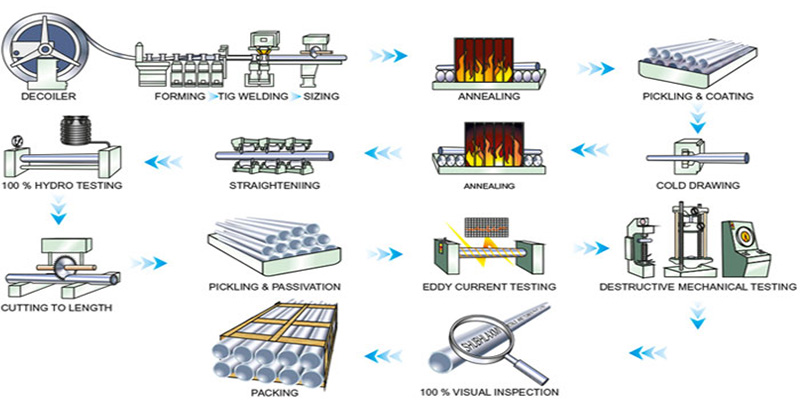
Step 1: Strip Preparation & Slitting
Stainless steel coils are uncoiled and flattened. A slitter cuts the strip to a specific width. The width of the strip determines the final pipe diameter.
Step 2: Forming
The strip passes through a series of forming rollers. Each roller bends the strip a little more until the edges meet to form an open-seamed round tube.
Step 3: Welding
The open seam is welded closed. For stainless steel pipes, TIG (GTAW), plasma welding, or laser welding are used because they create high-quality welds with minimal heat-affected zones.
After welding, excess weld metal is scraped off to create a smooth surface.
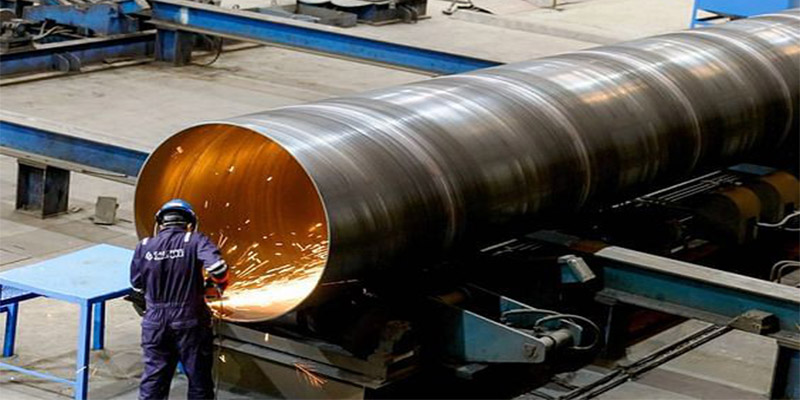
Step 4: Sizing & Shaping
The welded pipe goes through sizing rollers to ensure the outer diameter, roundness, and wall thickness meet the required tolerances.
Step 5: Non-Destructive Testing
The weld seam is tested online to catch any defects immediately.
Testing methods:
Eddy current testing: Can detect surface defects as shallow as 0.1 mm.
Ultrasonic testing can detect internal defects equivalent to a Φ2.0mm flat-bottomed hole
Step 6: Heat Treatment & Finishing
Like seamless pipes, welded pipes undergo solution annealing to eliminate weld stress and restore corrosion resistance. They then go through pickling, passivation, and straightening.
All pipes undergo rigorous quality control before shipment, regardless of manufacturing method.
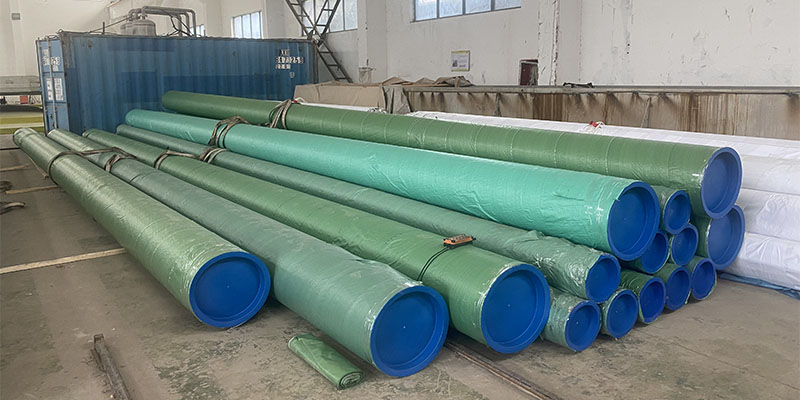
Mechanical & Chemical Testing
Tensile tests, flattening tests, flaring tests, and hardness tests are performed to verify that the mechanical properties of the pipes meet standard requirements. A spectrometer is also used to verify the chemical composition of the pipes.
Hydrostatic/Pneumatic Testing
Hydraulic or pneumatic pressure tests are performed on the pipes at specified pressures to verify their pressure resistance and leak-proof properties.
Dimensional & Visual Inspection
Using specialized measuring tools, the pipes' outer diameter, wall thickness, length, curvature, and other dimensions are precisely measured. The surface is then inspected for defects such as cracks and scratches.
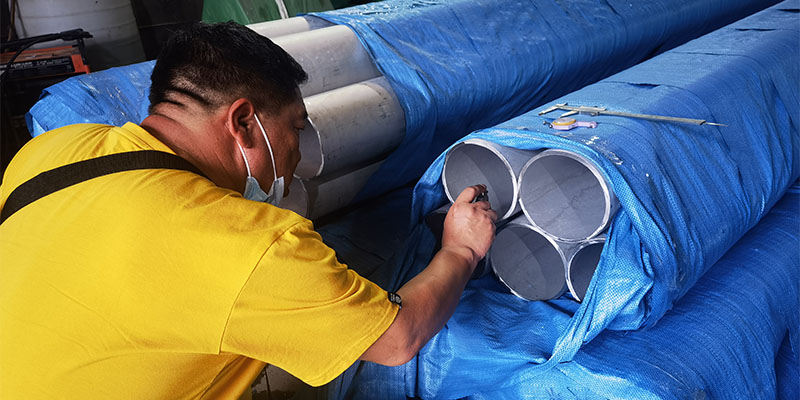
Marking & Packaging
Each pipe is marked with:
Steel grade (e.g., 304, 316L)
Heat batch number
Dimensions
Applicable standard
Pipes are packaged to prevent moisture and impact damage during shipping.
JN Special Alloy Technology Co., Ltd. is a leading stainless steel pipe manufacturer and supplier in China. We offer stainless steel, duplex steel, super duplex steel, and nickel alloy steel pipes. Every pipe produced by JN conforms to ASTM standards, and we accept custom sizes and flexible MOQs.
JN provides first-class customer service, available 24/7, especially for time-sensitive orders. From receiving your inquiry, providing a quote, signing the contract, paying the deposit, arranging production, packaging and shipping, to receiving the goods, we assign a sales representative to provide you with one-on-one service.
Throughout the entire ordering process, we are committed to ensuring your satisfaction.
Contact us now for the latest steel pipe quote!
U.S. Geological Survey (USGS). Chromium Statistics and Information.
U.S. Department of Energy (DOE). Advanced Manufacturing Office: Materials Research.
The Ohio State University (OSU). Department of Materials Science and Engineering: Principles of Metallurgy.
ASTM International. ASTM A312/A312M - Standard Specification for Seamless and Welded Austenitic Stainless Steel Pipes.


