
Views: 12 Author: Monica Publish Time: 2026-02-28 Origin: Site


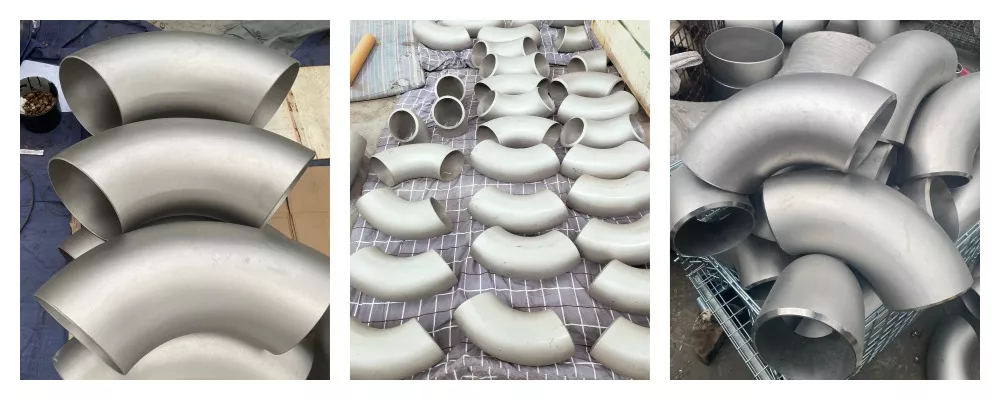
JN Alloy shipped 195 pieces of 316L stainless steel butt-weld elbows from Wuxi, China to a customer in Cartagena, Chile in February 2026. The order covered 45 and 90 degree long-radius elbows in sizes from 1/2" to 5", all to ASTM A270, with 1.2-2.0 mm wall thickness and an internal mechanical polish of Ra 0.8 um on a pickled outside surface. For buyers in Chile, the material decision behind an order like this matters more than the tonnage.
Chile is the world's largest copper producer and one of the largest food exporters in the Southern Hemisphere, and both industries put stainless steel in contact with chlorides - from seawater and salt-laden coastal air in the Valparaiso Region, to brines, salt and clean-in-place chemicals in food plants. That is why 316L was specified rather than the cheaper 304.TL;DR - 195 pieces, 11 line items, 1/2 inch to 5 inch, 45 and 90 degree long radius, ASTM A270 316L, Ra 0.8 um bore, pickled outside. Theoretical net weight 102.67 kg. 316L was chosen over 304 for chloride resistance: coastal marine atmosphere at Cartagena plus chlorinated clean-in-place chemistry in food service.
Order195 pieces, 11 line itemsMaterial316L stainless steel (UNS S31603)Configuration45 deg and 90 deg, long radius (1.5D)Size range1/2" to 5" nominal boreWall thickness1.2 mm to 2.0 mmSpecificationASTM A270, OD dimensions, plain endsSurface finishID mechanical polish Ra 0.8 um; OD pickledDestinationCartagena, Valparaiso Region, ChileTheoretical net weightapprox. 103 kg (227 lb)Port of dispatchWuxi, Jiangsu, China
The order was 195 pieces of 316L long-radius butt-weld elbows across 11 line items, ranging from 1/2" to 5" nominal bore, split between 45 and 90 degree configurations, with an internal Ra 0.8 um polish and pickled external surfaces.
The customer is an industrial engineering company carrying out a plant expansion project in Cartagena, in Chile's Valparaiso Region. The elbows are installed in the sections of the piping system where the line changes direction most frequently, which is also where flow turbulence and the risk of product hold-up are highest. In hygienic service, every change of direction is a potential cleaning dead leg, so both the radius and the internal finish matter as much as the grade. The line items below are reproduced exactly as they appeared on the original order schedule.
| DESCRIPTION | DIAMETER | QUANTITY | UNIT |
|---|---|---|---|
| 45 Degree Elbow With Butt Weld, Long Radius, DN 1 1/2", Stainless Steel 316L, ASTM A270, Outside Diameter (OD) dimensions, Plain Ends, Wall Thickness 1.5 mm, Inner Surface: Mechanical Polishing Ra 0.8μm and Outer Surface: Pickled | 1 1/2" | 5 | pieces |
| 45 Degree Elbow With Butt Weld, Long Radius, DN 2", Stainless Steel 316L, ASTM A270, Outside Diameter (OD) dimensions, Plain Ends, Wall Thickness 1.5 mm, Inner Surface: Mechanical Polishing Ra 0.8μm and Outer Surface: Pickled | 2" | 3 | pieces |
| 45 Degree Elbow With Butt Weld, Long Radius, DN 2", Stainless Steel 316L, ASTM A270, Outside Diameter (OD) dimensions, Plain Ends, Wall Thickness 2.0 mm, Inner Surface: Mechanical Polishing Ra 0.8μm and Outer Surface: Pickled | 5" | 5 | pieces |
| 90 Degree Elbow With Butt Weld, Long Radius, DN 1 1/2", Stainless Steel 316L, ASTM A270, Outside Diameter (OD) dimensions, Plain Ends, Wall Thickness 1.5 mm, Inner Surface: Mechanical Polishing Ra 0.8μm and Outer Surface: Pickled | 1 1/2" | 20 | pieces |
| 90 Degree Elbow With Butt Weld, Long Radius, DN 1 ", Stainless Steel 316L, ASTM A270, Outside Diameter (OD) dimensions, Plain Ends, Wall Thickness 1.5 mm, Inner Surface: Mechanical Polishing Ra 0.8μm and Outer Surface: Pickled | 1" | 15 | pieces |
| 90 Degree Elbow With Butt Weld, Long Radius, DN 1/2 ", Stainless Steel 316L, ASTM A270, Outside Diameter (OD) dimensions, Plain Ends, Wall Thickness 1.2 mm, Inner Surface: Mechanical Polishing Ra 0.8μm and Outer Surface: Pickled | 1/2" | 4 | pieces |
| 90 Degree Elbow With Butt Weld, Long Radius, DN 2 1/2", Stainless Steel 316L, ASTM A270, Outside Diameter (OD) dimensions, Plain Ends, Wall Thickness 1.5 mm, Inner Surface: Mechanical Polishing Ra 0.8μm and Outer Surface: Pickled | 2 1/2" | 4 | pieces |
| 90 Degree Elbow With Butt Weld, Long Radius, DN 2 ", Stainless Steel 316L, ASTM A270, Outside Diameter (OD) dimensions, Plain Ends, Wall Thickness 1.5 mm, Inner Surface: Mechanical Polishing Ra 0.8μm and Outer Surface: Pickled | 2" | 85 | pieces |
| 90 Degree Elbow With Butt Weld, Long Radius, DN 3 ", Stainless Steel 316L, ASTM A270, Outside Diameter (OD) dimensions, Plain Ends, Wall Thickness 2.0 mm, Inner Surface: Mechanical Polishing Ra 0.8μm and Outer Surface: Pickled | 3" | 20 | pieces |
| 90 Degree Elbow With Butt Weld, Long Radius, DN 4 ", Stainless Steel 316L, ASTM A270, Outside Diameter (OD) dimensions, Plain Ends, Wall Thickness 2.0 mm, Inner Surface: Mechanical Polishing Ra 0.8μm and Outer Surface: Pickled | 4" | 4 | pieces |
| 90 Degree Elbow With Butt Weld, Long Radius, DN 5 ", Stainless Steel 316L, ASTM A270, Outside Diameter (OD) dimensions, Plain Ends, Wall Thickness 2.0 mm, Inner Surface: Mechanical Polishing Ra 0.8μm and Outer Surface: Pickled | 5" | 30 | pieces |
Data note. Line 3 of the original schedule reads "DN 2 inch" in the description but "5 inch" in the diameter column, with a 2.0 mm wall. Every other 2 inch line uses a 1.5 mm wall and every 5 inch line uses 2.0 mm, so the diameter column has been read as correct. The original wording is retained here and the discrepancy is flagged rather than silently corrected.
About 103 kg, or roughly 0.10 tonne. The order is a small-bore, thin-wall hygienic package, not a heavy tonnage shipment.
The original version of this page described the order as 8 tons of elbows. That figure does not survive arithmetic. Each elbow is a thin-wall shell: a 2 inch long-radius 90 degree elbow with a 1.5 mm wall weighs roughly 0.22 kg, and the largest item in the order, a 5 inch long-radius 90 degree elbow with a 2.0 mm wall, weighs roughly 1.86 kg. Multiplying each line item by its quantity gives a theoretical net weight of 102.67 kg for all 195 pieces.
| Line item | Pieces | kg per piece | kg subtotal | lb subtotal |
|---|---|---|---|---|
| 45 deg LR, DN 1 1/2" | 5 | 0.061 | 0.31 | 0.7 |
| 45 deg LR, DN 2" | 3 | 0.110 | 0.33 | 0.7 |
| 45 deg LR, DN 5" | 5 | 0.932 | 4.66 | 10.3 |
| 90 deg LR, DN 1 1/2" | 20 | 0.123 | 2.46 | 5.4 |
| 90 deg LR, DN 1" | 15 | 0.053 | 0.80 | 1.8 |
| 90 deg LR, DN 1/2" | 4 | 0.010 | 0.04 | 0.1 |
| 90 deg LR, DN 2 1/2" | 4 | 0.347 | 1.39 | 3.1 |
| 90 deg LR, DN 2" | 85 | 0.221 | 18.74 | 41.3 |
| 90 deg LR, DN 3" | 20 | 0.664 | 13.28 | 29.3 |
| 90 deg LR, DN 4" | 4 | 1.188 | 4.75 | 10.5 |
| 90 deg LR, DN 5" | 30 | 1.864 | 55.91 | 123.3 |
| Total | 195 | - | 102.67 | 226.4 |
The calculation treats each elbow as a torus-segment shell using the outside diameter, the wall thickness and a long-radius centreline of 1.5D, at a density of 7.93 g/cm3 for 316L. It is a theoretical figure. Actual shipping weight will be higher once individual bagging, cartons, pallets and any crating are added; for a polished hygienic order of this type, expect 15 to 25 percent more on the air waybill or bill of lading.
Correction applied. The heading on the published page read "8 Tons Of 316L Stainless Steel Elbows". The verified theoretical net weight is 102.67 kg, so the heading has been rewritten to reference the piece count instead of an unsupported tonnage.
Because the grade, not the quantity, is what protects the customer's investment. In a coastal Chilean plant, 316L is specified for its molybdenum content, which is precisely the property that 304 does not have.
It is easy to read a small order like this as routine. It is not. Chile is an unusually chloride-heavy market for stainless steel, and the reason is structural rather than incidental: the country's two largest industrial sectors both handle salt. Copper is mined and refined in the desert north and along the coast, and food is processed and exported from the central and southern regions. Cartagena sits between those worlds, on the Pacific shore of the Valparaiso Region, next to the Quintero Bay industrial zone.
Copper mining and refining dominates, followed by seawater desalination serving those mines, then food processing - salmon and aquaculture, wine, fruit, dairy - and finally pulp, paper and chemicals. Every one of those sectors puts stainless steel in a chloride-bearing environment, which is why marine engineering and chemical equipment projects drive most of the demand for molybdenum-bearing grades.
| Industry | Scale in Chile | Where stainless is used | Grade typically specified |
|---|---|---|---|
| Copper mining and refining | World's largest producer; 5.42 Mt of copper in 2025, about 23% of global output | Raffinate and PLS lines, electrowinning cell house, acid handling, slurry and tailings, seawater and desalination circuits | 316L, 904L, duplex 2205/2507, Alloy 20 |
| Seawater desalination for mines | Multiple large plants supplying northern copper operations | Intake, pre-treatment, RO high-pressure and brine lines | Super duplex 2507, 904L, 254SMO |
| Salmon and aquaculture | One of the world's two largest farmed salmon producers | Processing lines, brine and chilling circuits, CIP systems, hygienic transfer piping | 316L, ASTM A270 sanitary tubing |
| Wine and fruit processing | Top-tier global exporter of wine, table grapes, cherries, blueberries and avocados | Juice and must lines, fermentation and tank cleaning, washdown areas, packaging halls | 304L and 316L, A270 hygienic fittings |
| Dairy and food manufacturing | Substantial domestic and export sector | Pasteurisers, CIP circuits, fillers, product-contact piping | 316L, A270, Ra 0.4-0.8 um finishes |
| Pulp, paper and chemicals | Established forestry and chemical base in the south | Digester and bleach plant piping, chemical recovery | 316L, 904L, duplex, Alloy 20 |
Chile produced about 5.42 million tonnes of copper in 2025, roughly 23 percent of world output, and falling ore grades mean the country must process steadily more rock for the same metal. That translates directly into more piping, more acid handling and more seawater.
Chilean copper output reached 5,415,200 tonnes in 2025, a decline of 1.65 percent from 5,505,900 tonnes in 2024, according to the Chilean Copper Commission. Chile has been the world's leading copper producer for decades and still accounts for close to a quarter of global supply. Within the country, Codelco, the state-owned producer, delivered about 1.334 million tonnes in 2025, while the Escondida operation controlled by BHP produced roughly 1.345 million tonnes. Codelco's capital expenditure reached a record of more than 5 billion US dollars in the same year, much of it directed at sustaining production from ageing deposits.
The number that matters most for material demand is not tonnage but grade. Average Chilean ore grades have fallen from around 1.4 percent copper in 1990 to roughly 0.8 to 0.9 percent today. Lower grade means more ore moved, crushed, leached and processed per tonne of metal, and it means more aggressive chemistry in the circuit. That shows up as expanded solvent extraction and electrowinning capacity, larger raffinate and pregnant leach solution lines, more sulfuric acid handling, and more chloride-bearing process streams. It also drives the single largest materials shift in Chilean mining: the move to seawater and desalinated water for operations in the Atacama, because fresh water is not available at the volumes required. Seawater at atmospheric temperature carries about 19,000 ppm of chloride, which places it far beyond the capability of either 304 or 316L and pushes those circuits toward super duplex 2507, 904L or 254SMO. The 316L in this order sits in the lower-chloride parts of that wider picture.
Large enough to be a national export pillar. Chile is one of the two biggest farmed salmon producers in the world and a leading exporter of wine, table grapes, cherries, blueberries and avocados - all of which are processed on hygienic stainless steel lines.
The food and beverage sector is the reason a specification like ASTM A270 exists in a Chilean purchase order at all. A270 governs stainless steel sanitary tubing, dimensioned on outside diameter rather than nominal pipe size, with thin walls and a polished bore. It is the standard you find in salmon processing and chilling lines, in winery must and juice circuits, in dairy pasteurisers, and in the clean-in-place loops that connect them. The elbows in this order, with their 1.2 to 2.0 mm walls and Ra 0.8 um internal polish, are typical of that service. The grade itself is described in full on the 316L stainless steel page.
Food duty is where the 316L decision becomes concrete. Chilean food plants are cleaned with chlorinated alkaline and nitric acid clean-in-place chemicals, often at elevated temperature. Salmon and seafood lines, brines, marinades, salt-containing sauces and pickled products all introduce chloride directly into contact with the metal. A 304L surface will survive dry, salt-free food handling perfectly well for decades, but repeated exposure to warm chlorinated cleaning chemistry is a different proposition. The molybdenum in 316L is what raises the pitting and crevice corrosion threshold above that regime, and the low carbon content keeps the weld heat-affected zones from sensitising. For a plant that runs clean-in-place several times a day, the grade is not a preference; it is the difference between a service life measured in decades and one measured in single-digit years.
Because airborne salt deposits chloride on every exposed surface, including surfaces that never touch process fluid. Coastal atmosphere alone is enough to pit 304 within a few years.
Cartagena lies on the Pacific coast in the Valparaiso Region, immediately adjacent to the Quintero Bay industrial area. Marine atmospheres of that type deposit chloride on exposed metal at rates high enough to break down the passive film on unstabilised grades. The failure mode is characteristic: tea staining first, then pitting that nucleates in crevices, under deposits and at weld toes, and eventually stress corrosion cracking if the component carries sustained tensile stress. None of this requires the part to be immersed in seawater. Coastal air plus a humid night is sufficient. That is the single most common reason a Chilean buyer specifies 316L for a line that an inland buyer would happily build in 304L.
| Service condition | Typical chloride level | 304 / 304L | 316L | Recommended grade |
|---|---|---|---|---|
| Dry indoor plant, no salt | Below 50 ppm | No pitting | No pitting | 304L is sufficient |
| Inland process water, moderate hardness | 50-300 ppm | Marginal; pitting possible over years | Good service | 304L, upgrade if welded heavily |
| Coastal marine atmosphere within a few km of the sea | Airborne deposition, salt-laden | Tea staining, pitting within 1-3 years on exposed surfaces | No pitting in decades | 316L minimum |
| Food plant washdown with chlorinated sanitiser | Transient 200-1,000 ppm | Pitting and staining at repeated exposure | Good service | 316L |
| Brine, salt, seafood and pickling duty | Above 1,000 ppm | Rapid pitting; SCC risk when warm | Good service up to about 2,000 ppm at ambient | 316L; duplex for hot brine |
| Seawater, warm, continuous immersion | About 19,000 ppm | Rapid failure | Limited life; pitting above about 60 C | Super duplex 2507, 904L, 254SMO |
Specify 316L whenever chlorides exceed roughly 300 ppm, whenever surfaces are regularly cleaned with chlorinated sanitisers, or whenever the installation sits within a few kilometres of the coast. Specify 304 or 304L only for dry, chloride-free, indoor duty, where the roughly 30 percent cost saving genuinely pays back.
The choice is frequently presented as a quality question. It is not. It is an exposure question. Both grades are austenitic, both are hygienic, both weld cleanly and both are approved for food contact. They differ in one chemistry decision - whether molybdenum is present - and that single difference sets the chloride ceiling for the whole installation. The practical rule for a Chilean project is to establish the chloride exposure of the specific line before choosing the grade, rather than defaulting to whichever grade the last project used. Where the answer is a different elbow geometry rather than a different grade, the selection logic is covered in how to choose a stainless steel elbow.
316L contains 2 to 3 percent molybdenum and caps carbon at 0.03 percent. 304 contains no molybdenum and allows up to 0.08 percent carbon. Everything else about their behaviour follows from those two facts.
| Element | 304 (S30400) | 304L (S30403) | 316 (S31600) | 316L (S31603) | What it does |
|---|---|---|---|---|---|
| Carbon, max | 0.08 | 0.030 | 0.08 | 0.030 | Low carbon limits carbide precipitation at welds |
| Chromium | 18.0-20.0 | 18.0-20.0 | 16.0-18.0 | 16.0-18.0 | Builds the passive chromium-oxide film |
| Nickel | 8.0-10.5 | 8.0-12.0 | 10.0-14.0 | 10.0-14.0 | Stabilises austenite; toughness and formability |
| Molybdenum | none | none | 2.00-3.00 | 2.00-3.00 | Resists pitting and crevice corrosion in chlorides |
| Nitrogen, max | 0.10 | 0.10 | 0.10 | 0.10 | Contributes to PREN and strength |
| Manganese, max | 2.00 | 2.00 | 2.00 | 2.00 | Deoxidation |
| Silicon, max | 0.75 | 0.75 | 0.75 | 0.75 | Deoxidation |
| Phosphorus, max | 0.045 | 0.045 | 0.045 | 0.045 | Trace; controlled for weldability |
| Sulfur, max | 0.030 | 0.030 | 0.030 | 0.030 | Trace; controlled for weldability |
| PREN (typical) | 18.0-19.3 | 18.0-19.3 | 24-26 | 24-25 | Single-number ranking of pitting resistance |
Chromium creates the passive oxide film that makes stainless steel stainless, and both grades carry broadly similar chromium levels - 18 to 20 percent in 304, 16 to 18 percent in 316L. Nickel stabilises the austenitic structure and gives both grades their toughness and formability, with 316L running slightly higher at 10 to 14 percent. The decisive difference is molybdenum. Molybdenum strengthens the passive film against localised breakdown by chloride ions, which is the mechanism behind pitting and crevice corrosion.
Remove it and you remove the chloride tolerance. The carbon limit matters for a different reason: carbon above roughly 0.03 percent can combine with chromium at weld heat-affected zones to form chromium carbides, depleting the surrounding metal of the chromium it needs to stay passive. That is sensitisation, and it is why the L grades exist. In a fabricated hygienic system with hundreds of welds, sensitisation at a single weld can be the start of a failure. The full comparison across properties and applications is set out in 304 vs 316 stainless steel.
It raises the potential that chloride ions must overcome before they can break through the passive film, which pushes the pitting threshold roughly ten times higher than 304 in practical terms.
Pitting begins when chloride ions locally displace oxygen from the passive chromium-oxide film and the film cannot repair itself fast enough. Molybdenum slows that displacement and helps re-passivate the pit once it has started, which is why molybdenum-bearing grades tolerate far more chloride before localised attack begins. Published practical figures put the ambient chloride ceiling for 304 at roughly 100 to 300 ppm, and for 316L at roughly 2,000 ppm. The gap is not marginal. It is the difference between a coastal washdown area and a dry indoor packaging hall.
PREN for 304 is about 18 to 19.3 and for 316L about 24 to 25. As a working rule, a PREN above 25 is where reliable chloride handling begins - which places 316L just over the line and 304 clearly below it.
The Pitting Resistance Equivalent Number condenses the chemistry into one comparable figure: PREN equals chromium plus 3.3 times molybdenum plus 16 times nitrogen. Because 304 has no molybdenum, its PREN stays close to its chromium content. The number is a ranking tool, not a corrosion study, and it is important to note what it does not measure: PREN ranks pitting resistance, not stress corrosion cracking resistance. A grade with a high PREN can still crack under the combined action of tensile stress, temperature and chloride. The second metric, critical pitting temperature, is measured rather than calculated. In a 3.5 percent sodium chloride solution per ASTM G150, 304 typically pits at around 22 C, while 316L holds above 30 C. Those two numbers, PREN and CPT together, are the fastest way to screen a grade against a specific Chilean duty.
| Grade | UNS | PREN | CPT in 3.5% NaCl (ASTM G150) | Practical chloride ceiling at ambient | Relative material cost |
|---|---|---|---|---|---|
| 304 / 304L | S30400 / S30403 | 18-19.3 | About 22 C | About 100-300 ppm | 1.00x |
| 316 / 316L | S31600 / S31603 | 24-26 | Above 30 C | About 2,000 ppm | 1.28-1.38x |
| 904L | N08904 | About 35.7 | Above 55 C | Above 10,000 ppm | 2.5-3.0x |
| 2205 duplex | S32205 | About 34-36 | Above 50 C | Above 5,000 ppm | 1.6-1.9x |
| 2507 super duplex | S32750 | About 42-43 | Above 70 C | Seawater capable | 2.2-2.6x |
| 254SMO / 6Mo | S31254 | About 43 | Above 70 C | Seawater capable | 3.0-3.5x |
Match the grade to the chloride exposure of the specific line, not to the plant as a whole. Different lines in the same facility can legitimately require different grades.
| Application | Chlorides present? | Sanitary / CIP? | Specify | Reason |
|---|---|---|---|---|
| Coastal plant structural and support steel | Airborne salt | No | 316L | Marine atmosphere pits 304 within a few years |
| Dry indoor conveyor framing, guards, covers | None | No | 304 or 304L | No chloride mechanism; the 316L premium does not pay back |
| Product-contact hygienic piping | Yes, from cleaning | Yes | 316L, A270 | Ra finish plus Mo for CIP chemicals |
| Brine, salt and seafood circuits | Above 1,000 ppm | Yes | 316L | 304 pits rapidly in warm brine |
| Wine, juice and must lines | Low to moderate | Yes | 304L or 316L | Acidity plus washdown; 316L where chloride sanitisers are used |
| Dairy and pasteuriser circuits | Chlorinated CIP | Yes | 316L | Warm chloride CIP attacks 304 |
| Seawater cooling, once-through | About 19,000 ppm | No | Super duplex 2507 or 904L | 316L has limited life in warm seawater |
| Copper SX-EW and acid handling | Acid plus chloride traces | No | 316L, 904L or Alloy 20 | Sulfuric acid duty with chloride impurities |
| Sour gas or H2S service | Sulfide | No | Per NACE MR0175 / ISO 15156 | Grade limits set by partial pressure, not by PREN |
On any line with real chloride exposure, yes - typically within about four years. On a dry indoor line with no chlorides, no, and 304L is the correct engineering choice.
316L carries a material premium of roughly 28 to 35 percent over 304L, driven mainly by molybdenum and nickel content. That premium is easy to resist on a purchase order and hard to justify resisting over a plant lifetime.
The comparison that matters is not cost per kilogram but cost per year of service, and in chloride service 304L fails by pitting rather than by gradual thinning - which means it fails suddenly, at a weld or a crevice, and usually during operation rather than during a planned outage. Once the cost of a shutdown, a product loss and an emergency fabrication is included, the 304L saving is consumed by the first failure. The honest counter-argument is equally worth stating: specifying 316L for a dry, salt-free, indoor application pays a 30 percent premium for no benefit whatsoever.
| Item | 304L | 316L | Comment |
|---|---|---|---|
| Relative material cost (FOB Asia, 2026) | 1.00x | 1.28-1.38x | Driven mainly by molybdenum and nickel content |
| Expected service life, coastal or high-chloride line | About 8 years before pitting failure | About 25 years | Failure is by pitting then SCC, not general thinning |
| Replacement cycles over 25 years | 3 | 0 | Each cycle carries material, fabrication and shutdown cost |
| Shutdown and lost-production cost | Recurs each cycle | Avoided | Usually the dominant term in the comparison |
| Typical payback on the 316L premium | - | About 4 years | On any line with real chloride exposure |
When chlorides are hot, concentrated and continuous, or when hydrogen sulfide is present. Neither 304 nor 316L is a seawater material, and sour service is governed by a separate standard rather than by PREN.
316L is a general-purpose chloride-resistant grade, not a universal one. Its limits become visible in three situations: continuous warm seawater immersion, hot chloride under sustained tensile stress, and wet hydrogen sulfide. In each case the correct response is a different material family, not a thicker wall or a better finish. Naming the upgrade path explicitly at the design stage is far cheaper than discovering the limit in service. Where duplex is the answer, the material family is described on the duplex stainless steel pipe page.
| Condition that defeats 316L | Trigger threshold | Upgrade to | Why |
|---|---|---|---|
| Warm or hot seawater | Continuous immersion above about 60 C | Super duplex 2507, 254SMO, 904L | PREN 24-25 is insufficient; need PREN above 40 |
| Chloride stress corrosion cracking | Hot chloride plus sustained tensile stress | Duplex 2205 or 2507 | Ferrite-austenite microstructure resists SCC |
| Sour service with wet H2S | Per NACE MR0175 / ISO 15156 partial pressure limits | Grades qualified to the standard; hardness capped at 22 HRC | Both 304 and 316L fall outside the envelope at higher partial pressures |
| Hot concentrated sulfuric acid | Above about 50 C and 50% concentration | Alloy 20, 904L, Hastelloy C276 | Molybdenum and copper needed for acid service |
| Chloride plus oxidising acid | Mixed duty | Hastelloy C276, C22 | Nickel-molybdenum chemistry for the harshest mixed duty |
The elbows were manufactured to ASTM A270, the sanitary tubing specification, and not to ASTM A403, which governs pressure-piping butt-weld fittings. The distinction is deliberate and it is the detail that tells you what the fittings are for.
This is the point on which the published version of this page was internally inconsistent: the order schedule correctly cited ASTM A270 while the body text cited ASTM A403. The schedule was right. A270 covers sanitary tubing dimensioned on outside diameter with thin walls and a polished bore, which matches the stated 1.2 to 2.0 mm walls, the OD dimension basis, the plain ends and the Ra 0.8 um internal polish exactly. A403 covers wrought fittings dimensioned on nominal pipe size to ASME B16.9 with schedules from 5S upward, and it does not carry a polished bore requirement. A buyer reading a quotation that mixes the two will not know whether they are purchasing hygienic tubing components or pressure piping components, and the two are not interchangeable. The A403 side of that distinction is illustrated by WP317L A403 fittings and by ASME SA403 254SMO pipe fittings.
A270 applies when the bore must be polished and the fitting must drain clean for hygienic service. A403 applies when the fitting is a pressure-containing component in a process piping system designed to ASME B31.3. Some projects need both, on different lines.
| Point of comparison | ASTM A270 (this order) | ASTM A403 |
|---|---|---|
| Product covered | Seamless and welded austenitic and ferritic/austenitic stainless steel sanitary tubing and matching fittings | Wrought austenitic stainless steel fittings for pressure piping |
| Dimension basis | Outside diameter (OD) and wall thickness | Nominal pipe size (NPS) per ASME B16.9 / B16.28 / MSS SP-43 |
| Typical wall | Thin wall, 1.2-2.0 mm in this order | Schedule 5S through XXS |
| Grade prefix | Grade named directly, e.g. 316L | WP for wrought, CR for corrosion-resistant per MSS |
| End preparation | Plain or bevelled hygienic ends | Beveled per ASME B16.25 |
| Surface requirement | Polished bore, typically Ra 0.8 um or better | Not normally specified; pickled or blasted |
| Primary service | Food, dairy, beverage, pharmaceutical, biotech | Process piping in chemical, petrochemical, power, water treatment |
| Governing design code | Hygienic design guidance such as 3-A and EHEDG; product contact rules | ASME B31.3 process piping |
A long-radius elbow has a centreline radius of 1.5 times the pipe diameter, against 1.0 times for short radius. The gentler bend lowers pressure drop, reduces turbulence and drains better - all of which matter in hygienic and slurry duty.
Every elbow in this order is long radius. In a food or pharmaceutical line, a long-radius bend presents a smoother swept path to the cleaning fluid, which reduces the risk of residue surviving a clean-in-place cycle. In slurry and solids-handling duty, the same geometry lowers the local velocity peak that drives erosion at the outer bend. Short-radius elbows are chosen when space is genuinely constrained - inside a skid, for example - and the pressure-drop penalty is acceptable. Because long-radius elbows take up roughly one and a half times the footprint of a short-radius elbow of the same size, the choice has to be made at the piping layout stage, not at the purchasing stage. The geometry itself is explained on the long radius elbow page, and the wider range on steel elbow and 90 degree elbow pages.
Ra 0.8 um is the standard product-contact finish for general food service. It is achieved by progressive mechanical polishing, and it must be protected after fabrication rather than restored after installation.
Ra is the arithmetic mean roughness of the surface profile, expressed in micrometres. Lower is smoother. Hygienic design guidance converges on Ra 0.8 um or better for general food contact, and Ra 0.4 um or better where biofilm risk is critical, such as dairy and liquid product lines. The reason is cleanability rather than corrosion: a rough surface shelters micro-organisms from the cleaning chemistry, and no amount of chemical strength compensates for a surface that harbours them. A polished bore also removes the crevices, tool marks and weld spatter that would otherwise become pitting initiation sites in chloride service. This order pairs a polished bore with a pickled outside surface, which is the conventional and cost-effective combination: polish where the product touches, pickle where it does not. Matching fittings for the same hygienic lines are listed under 316 stainless steel pipe fittings.
| Finish | Typical Ra | Where it is specified | Method |
|---|---|---|---|
| Mill / as-welded | Above 3.2 um | Non-product-contact structural and utility lines | As supplied |
| Pickled and passivated | 1.6-3.2 um | External surfaces, general chemical plant piping | Acid pickling then passivation |
| Mechanical polish, this order | 0.8 um | General food contact, product-contact piping | Progressive abrasive polishing |
| Fine mechanical polish | 0.4 um | Dairy, liquid product, high biofilm risk | Fine abrasive plus electropolish |
| Electropolished | 0.2-0.4 um | Pharmaceutical, biotech, aseptic | Electrochemical removal of the surface layer |
Each fitting was verified against the order schedule for chemistry, dimensions and surface finish, with positive material identification to prevent grade mix-up, and the shipment was documented with an EN 10204 Type 3.1 mill test certificate.
The most common quality failure in a 316L order is not a manufacturing defect at all. It is a grade mix-up - a 304 fitting entering a 316L package, usually through a shared polishing or packing station. Because the two grades look identical and are both non-magnetic in the annealed condition, visual inspection cannot detect it and a magnet cannot either. Positive material identification is the control that closes that gap. The same discipline applies across the wider families, including butt weld pipe fittings, forged pipe fittings, tees and reducers.
Review the order schedule against the drawing, confirming angle, radius, size, wall thickness and surface finish for each line item.
Verify heat chemistry against the 316L limits of ASTM A270, and confirm tensile properties from the mill certificate.
Perform positive material identification on finished fittings by X-ray fluorescence or optical emission spectrometry to confirm the molybdenum content is present.
Measure outside diameter, wall thickness and centre-to-end radius against the order schedule.
Check internal surface roughness against the Ra 0.8 um requirement using a comparator or profilometer.
Pickle and passivate the external surface, then rinse and dry to remove free iron contamination.
Bag, carton and pallet the fittings by line item so that the packing list matches the schedule one-to-one.
Protect polished bores with end caps or sleeves, and seal against moisture for the ocean voyage.
Issue the mill test certificate, packing list and any supplementary test reports with the shipment.
| Check | What it verifies | Standard or practice |
|---|---|---|
| Chemical analysis | Heat chemistry conforms to 316L limits | ASTM A270 / A751 |
| Tensile test | Yield and tensile strength, elongation | ASTM A370 |
| PMI on finished fittings | No grade mix-up between 304 and 316L on the shop floor | XRF or OES, 100% or sample |
| Dimensional check | OD, wall thickness, centre-to-end radius | ASTM A270 plus order drawing |
| Surface roughness check | Internal Ra meets 0.8 um | Comparator or profilometer |
| Hydrostatic or eddy current test | No through-wall defects | ASTM A270 supplementary requirements |
| Intergranular corrosion test | Resistance to sensitisation after forming | ASTM A262 Practice E, when specified |
| Mill test certificate | Traceability from heat number to finished part | EN 10204 Type 3.1 |
Packing for a sea voyage from China to Chile deserves particular attention on a polished hygienic order. Transit times are long, humidity in a container is high, and a polished bore that arrives with rust bloom or mechanical damage is a rejected delivery. Individual bagging, end protection on the polished surfaces, and moisture control in the container are all part of protecting the finish that the customer paid for.
Fourteen standards are relevant to this order, spanning the product specification, the dimensional standards, the corrosion test methods and the documentation requirement. The product specification is ASTM A270; the corrosion data in this article comes from ASTM G48 and G150.
Buyers evaluating a quotation for 316L fittings should be able to match every claim on the supplier's certificate to a named standard. Where a supplier quotes a grade without a specification, or a specification without an edition, the buyer has no basis for comparison. The table below lists the standards referenced throughout this case study so that the claims made here can be checked directly. The dimensional standards behind those tables are set out in ASME B16.9 butt welding fittings dimensions and ASME B16.28 short radius elbows, and the size basis in stainless steel pipe dimensions and chart.
| Standard | Title / scope | Relevance here |
|---|---|---|
| ASTM A270 / A270M | Seamless and welded austenitic and ferritic/austenitic stainless steel sanitary tubing | The product specification for these elbows |
| ASTM A403 / A403M | Wrought austenitic stainless steel piping fittings | The pressure-piping alternative; not used on this order |
| ASTM A312 / A312M | Seamless, welded and heavily cold worked austenitic stainless steel pipe | Matching pipe for the same lines |
| ASTM A240 / A240M | Chromium and nickel stainless steel plate, sheet and strip | Composition limits quoted in Table 5 |
| ASTM A960 / A960M | Common requirements for wrought steel piping fittings | General requirements, marking and testing |
| ASME B16.9 | Factory-made wrought buttwelding fittings | Dimensional standard for A403 fittings |
| ASME B16.28 | Wrought steel buttwelding short radius elbows and returns | Short radius geometry reference |
| ASME B31.3 | Process piping | Design code for pressure piping, including dissimilar joints |
| ASTM A262 Practice E | Detecting susceptibility to intergranular attack in austenitic stainless steels | Sensitisation check on formed and welded parts |
| ASTM G48 | Pitting and crevice corrosion resistance by ferric chloride solution | Test method behind published corrosion data |
| ASTM G150 | Electrochemical critical pitting temperature testing | Source of the CPT values in Table 6 |
| NACE MR0175 / ISO 15156 | Materials for use in H2S-containing environments in oil and gas | Sour service limits referenced in Table 9 |
| EN 10204 | Metallic products - types of inspection documents | Type 3.1 mill test certificate |
| MSS SP-43 | Wrought and fabricated butt-welding fittings for low pressure, corrosion resistant applications | Light-wall stainless fitting practice |
| 3-A Sanitary Standards and EHEDG guidelines | Hygienic design of food contact equipment | Surface finish and drainability expectations |
What was shipped in this order to Chile?
195 pieces of 316L stainless steel long-radius butt-weld elbows in 11 line items, ranging from 1/2" to 5" nominal bore. The order comprised both 45 degree and 90 degree configurations, all manufactured to ASTM A270 with 1.2 to 2.0 mm wall thickness, an internal mechanical polish of Ra 0.8 um and a pickled external surface. The destination was a plant expansion project in Cartagena, in Chile's Valparaiso Region.
How much did the 195 elbows weigh?
Approximately 102.67 kg, or about 0.10 tonne, as a theoretical net weight calculated from the stated outside diameters, wall thicknesses and long-radius centrelines at a density of 7.93 g/cm3 for 316L. Actual shipping weight including bagging, cartons, pallets and any crating will be 15 to 25 percent higher. An earlier version of this page stated 8 tons, which was incorrect by a factor of about 78.
Can 316L elbows be welded to 304 pipe?
Yes. Both grades are austenitic stainless steels with matching crystal structures and very similar thermal expansion behaviour, so they weld to each other cleanly. The standard practice is to use a 316L filler metal such as ER316L, or an over-alloyed consumable such as ER309L for the transition. The welded joint will behave as 304 does in service, because the lower-alloy side governs corrosion performance. If the line requires 316L corrosion resistance throughout, do not mix the grades.
Why were 316L elbows specified instead of 304 for this Chile project?
Because of chloride exposure. Cartagena sits on the Pacific coast, where airborne salt deposits chloride on exposed surfaces even indoors-adjacent areas. In addition, food-grade and process plant service involves chlorinated clean-in-place chemicals, brines and salt-bearing products. The molybdenum in 316L raises the pitting resistance threshold roughly tenfold compared with 304, which is what makes a multi-decade service life realistic in that environment.
What is the difference between 316L and 304 stainless steel?
316L contains 2 to 3 percent molybdenum and limits carbon to 0.03 percent maximum. 304 contains no molybdenum and permits up to 0.08 percent carbon. The molybdenum strengthens the passive film against chloride attack, and the lower carbon limit prevents chromium carbide precipitation at weld heat-affected zones. In every other respect - chromium, nickel, manganese, silicon, formability and weldability - the two grades are broadly similar, which is why they are so often confused.
What is PREN and what does it tell you about 316L versus 304?
PREN is the Pitting Resistance Equivalent Number, calculated as chromium plus 3.3 times molybdenum plus 16 times nitrogen. It condenses the chemistry into a single comparable figure. 304 scores about 18 to 19.3, while 316L scores about 24 to 25. A PREN above 25 is generally taken as the point at which reliable chloride handling begins, which places 316L just over the threshold and 304 clearly below it. PREN ranks pitting resistance only; it does not predict stress corrosion cracking resistance.
What chloride level is safe for 304 compared with 316L?
Published practical figures put the ambient chloride ceiling at roughly 100 to 300 ppm for 304 and roughly 2,000 ppm for 316L. The 304 threshold falls sharply as temperature rises, and above about 60 C with tensile stress present, 304 can crack with little warning. 316L remains serviceable to around 1,000 ppm at 60 C. Neither grade is suitable for continuous seawater immersion, which carries about 19,000 ppm of chloride.
What is the difference between ASTM A270 and ASTM A403?
ASTM A270 covers seamless and welded austenitic and ferritic/austenitic stainless steel sanitary tubing and matching fittings, dimensioned on outside diameter with thin walls and a polished bore. ASTM A403 covers wrought austenitic stainless steel fittings for pressure piping, dimensioned on nominal pipe size to ASME B16.9 or B16.28, with wall schedules from 5S upward. A270 is the correct specification for hygienic food, dairy and pharmaceutical service; A403 is the correct specification for pressure piping designed to ASME B31.3.
Why does this order use ASTM A270 rather than ASTM A403?
Because the fittings are hygienic components, not pressure piping components. The order schedule specifies outside diameter dimensions, plain ends, 1.2 to 2.0 mm thin walls and an internal Ra 0.8 um polish - all of which are A270 characteristics. A403 fittings are dimensioned on nominal pipe size and do not carry a polished bore requirement. The published version of this page cited A403 in the body text while the order schedule correctly cited A270; the body text has been corrected.
Why long radius elbows rather than short radius?
A long-radius elbow has a centreline radius of 1.5 times the pipe diameter, compared with 1.0 times for short radius. The gentler bend produces lower pressure drop and less turbulence, and it drains more completely - all of which matter in hygienic service, where residual product left after cleaning is a contamination risk. In slurry duty the same geometry reduces erosion at the outer bend. Short-radius elbows are chosen only where space is genuinely constrained.
What does an Ra 0.8 micrometre internal polish mean?
Ra is the arithmetic mean roughness of the surface profile in micrometres, so lower values mean a smoother surface. Ra 0.8 um is the standard product-contact finish for general food service, and Ra 0.4 um or better is used where biofilm risk is critical, such as dairy and liquid product lines. The purpose is cleanability: a rough surface shelters micro-organisms from cleaning chemistry, and it also provides crevices where pitting can initiate in chloride service.
What is the difference between a pickled and a polished surface?
Pickling removes the surface layer with acid, stripping out heat tint, scale and embedded free iron, and leaves a matte finish typically around 1.6 to 3.2 um Ra. Polishing mechanically abrades the surface to a specified smoothness, achieving 0.8 um Ra or better. This order uses both, in the conventional combination: polished on the inside where the product contacts the metal, and pickled on the outside where it does not.
Is 316L stainless steel magnetic?
In the annealed condition, 316L is essentially non-magnetic. Cold working - bending, drawing, or machining - can transform part of the austenitic structure to martensite and make the affected area weakly magnetic. This means a magnet cannot be used to distinguish 304 from 316L, since both behave the same way. Positive material identification by X-ray fluorescence or optical emission spectrometry is the reliable method.
What is the difference between 316 and 316L?
The only meaningful difference is the carbon limit. Standard 316 permits up to 0.08 percent carbon; 316L caps it at 0.03 percent. The lower carbon content prevents chromium carbide precipitation at weld heat-affected zones, which is why 316L is the default specification for welded piping and fabricated hygienic systems. For unwelded components in mild service, 316 offers marginally higher strength and is sometimes selected on that basis.
What is the maximum service temperature for 316L?
Continuous service is generally limited to about 425 C to avoid carbide precipitation in the 0.03 percent carbon grade, and the material is not normally selected for sustained service above roughly 800 C, where oxidation and sigma phase formation become concerns. For high-temperature service, stabilised or higher-alloy grades such as 321, 347H or 310S are preferred. The relevant limit for this order is far lower, since food and hygienic service operates well within the ambient to pasteurisation range.
Why does 316L cost more than 304, and when does it pay back?
316L carries a material premium of roughly 28 to 35 percent over 304L, driven mainly by its molybdenum and higher nickel content. On any line with genuine chloride exposure, that premium typically pays back in about four years, because 304L fails by sudden pitting rather than gradual thinning, and the cost of an unplanned shutdown, product loss and emergency replacement quickly exceeds the initial saving. On dry, chloride-free, indoor duty, the premium does not pay back and 304L is the correct choice.
When should you upgrade from 316L to duplex 2205 or 904L?
Upgrade when chlorides are hot, concentrated or continuous. Continuous warm seawater immersion, hot chloride under sustained tensile stress, and hot concentrated sulfuric acid all exceed what 316L can deliver. Duplex 2205 and 2507 resist chloride stress corrosion cracking through their ferrite-austenite microstructure and offer PREN values of about 34 to 43. 904L and 254SMO provide high molybdenum and nickel content for aggressive acid and chloride duty. For mixed chloride and oxidising acid service, Hastelloy C276 or C22 is the appropriate family.
What documentation should accompany a 316L fitting shipment?
At minimum, an EN 10204 Type 3.1 mill test certificate showing heat chemistry and mechanical properties, a packing list that maps one-to-one to the order schedule, and positive material identification records confirming the presence of molybdenum. Supplementary reports such as ASTM A262 Practice E intergranular corrosion test results, surface roughness measurements and hydrostatic or eddy current test records are commonly specified for hygienic and critical service orders.
How are polished 316L elbows protected during ocean shipping?
Individual bagging, end caps or sleeves on the polished bores, and moisture control inside the container. Transit from China to Chile is long and container humidity is high, so the main risks are rust bloom from condensation and mechanical damage in transit. A polished bore that arrives with either is a rejected delivery, which is why the finish specified at order stage has to be actively protected through packing and shipping rather than restored on arrival.
Can these 316L elbows be used in copper mining operations?
In the lower-chloride parts of a copper circuit, yes - for example in reagent dosing, some utility and instrumentation lines, and lower-temperature process water. They are not suitable for seawater or desalination brine duty, where chloride levels around 19,000 ppm require super duplex 2507, 904L or 254SMO, nor for hot concentrated sulfuric acid service, where Alloy 20 or Hastelloy C276 is more appropriate. The governing factor is the chloride and acid exposure of the specific line, not the industry it belongs to.
| Term | Definition |
|---|---|
| Austenitic stainless steel | The 300-series family, with a face-centred cubic crystal structure stabilised by nickel. Non-magnetic when annealed, highly formable and weldable. Includes 304, 316, 316L, 321, 347 and 904L. |
| ASTM A270 | Specification covering seamless and welded austenitic and ferritic/austenitic stainless steel sanitary tubing and matching fittings, dimensioned on outside diameter with a polished bore. The product specification for this order. |
| ASTM A403 | Specification covering wrought austenitic stainless steel fittings for pressure piping, dimensioned on nominal pipe size to ASME B16.9, B16.28 or MSS SP-43, with grade prefixes WP and CR. |
| Butt weld | A joint in which two components are aligned end to end and joined by a full-penetration circumferential weld. Standard for pipe and fittings above roughly 2 inch nominal bore. |
| Chloride stress corrosion cracking (SCC) | Cracking caused by the combined action of chloride, elevated temperature and sustained tensile stress. A separate failure mechanism from pitting, and not predicted by PREN. |
| Crevice corrosion | Localised attack in a shielded geometry - under a gasket, in a lap joint, beneath a deposit - where the local chemistry becomes depleted in oxygen and enriched in chloride. 316L resists it better than 304 because of molybdenum. |
| Critical pitting temperature (CPT) | The temperature at which pitting initiates under a specified test condition, measured per ASTM G150 in a 3.5 percent sodium chloride solution. About 22 C for 304 and above 30 C for 316L. |
| DN and NPS | Nominal diameter and nominal pipe size - dimensionless designators for pipe bore. DN 50 corresponds approximately to NPS 2. The original order schedule mixes the two conventions. |
| Electropolishing | An electrochemical process that removes a thin layer of surface metal, reducing roughness to 0.2-0.4 um Ra and enriching the surface in chromium. Used for pharmaceutical and aseptic service. |
| EN 10204 Type 3.1 | Inspection document issued by the manufacturer, certifying that the delivered product complies with the order, with test results traceable to the specific heat. The standard mill test certificate for this type of order. |
| Heat-affected zone (HAZ) | The region of base metal adjacent to a weld that has been metallurgically altered by welding heat but not melted. The location of most sensitisation and pitting failures in stainless steel. |
| Hygienic design | Design practice for food, dairy and pharmaceutical equipment, covering surface finish, drainability, crevice elimination and cleanability. Codified in 3-A Sanitary Standards and EHEDG guidelines. |
| Intergranular corrosion | Attack along grain boundaries, typically caused by sensitisation - chromium carbide precipitation depleting the surrounding metal of chromium. Detected by ASTM A262 Practice E. |
| Long radius (LR) elbow | An elbow with a centreline radius of 1.5 times the nominal pipe diameter, against 1.0 times for a short-radius elbow. Lower pressure drop and better drainability. |
| Molybdenum | Alloying element added at 2 to 3 percent in 316L. Strengthens the passive film against chloride breakdown, raising the practical chloride ceiling from roughly 100-300 ppm in 304 to roughly 2,000 ppm. |
| Passivation | Chemical or electrochemical treatment that removes free iron and other contamination from a stainless surface and allows the chromium-oxide passive film to reform. Usually performed after pickling. |
| Pickling | Acid treatment that removes heat tint, scale and embedded iron from a stainless surface, leaving a clean, passive, matte finish typically 1.6-3.2 um Ra. |
| Positive material identification (PMI) | Non-destructive verification of alloy composition on finished parts, by X-ray fluorescence or optical emission spectrometry. The control that prevents 304 and 316L being mixed up, since neither visual inspection nor a magnet can distinguish them. |
| PREN | Pitting Resistance Equivalent Number, calculated as chromium plus 3.3 times molybdenum plus 16 times nitrogen. About 18-19.3 for 304 and about 24-25 for 316L. A value above 25 is the practical threshold for reliable chloride service. |
| Ra | Arithmetic mean roughness of a surface profile, in micrometres. Lower values indicate a smoother surface. Ra 0.8 um is the standard product-contact finish for general food service; 0.4 um for dairy and liquid product. |
| Sanitary tubing | Stainless tubing manufactured to outside-diameter dimensions with a polished bore, for hygienic product-contact service in food, dairy, beverage and pharmaceutical plants. Governed by ASTM A270. |
| Sensitisation | Depletion of chromium in the grain boundaries or heat-affected zone caused by chromium carbide precipitation, usually from welding a grade with more than about 0.03 percent carbon. The reason the L grades exist. |
| Short radius (SR) elbow | An elbow with a centreline radius equal to 1.0 times the nominal pipe diameter. Used where space is constrained, at the cost of higher pressure drop. |
| Super duplex | A high-alloy duplex stainless steel with a PREN above 40, such as 2507 (UNS S32750). Used for seawater and high-chloride service where 316L is not sufficient. |
316L stainless steel - the grade used in this order, with full composition and property data.
304 vs 316 stainless steel - the comparison in this article, expanded across properties and applications.
Steel elbow - the full elbow range, including 45, 90 and 180 degree configurations.
How to choose a stainless steel elbow - angle, radius, size and finish selection.
What is a long radius elbow? - the geometry specified throughout this order.
316 stainless steel pipe fittings - matching fittings for the same lines.
Butt weld pipe fittings - the wider product family and its dimensional standards.
9 units of long radius 90 degree elbows shipped to Turkey - a comparable small-bore elbow shipment.
Chemical equipment - the sector page for process plant materials.
Marine engineering - materials for coastal and offshore chloride environments.
304L stainless steel - the low-carbon grade this article compares against 316L.
What is 316L stainless steel? - composition, properties and applications.
904L stainless steel and 254SMO - the upgrade path for seawater and high-chloride duty.
Flanges - the matching flange range for these lines.
Frequently asked questions - answers across the full product range.
JN Alloy supplies stainless steel and nickel alloy elbows, tees, reducers, caps, flanges, pipe, tube, plate and bar to ASTM and ASME specifications, with EN 10204 Type 3.1 mill test certificates, positive material identification and full traceability. Tell us your service conditions and we will help you match the grade to the line.
View 316L stainless steel products


