
Views: 0 Author: Monica Publish Time: 2026-11-13 Origin: Site


Table of Contents
Super Duplex S32750 (UNS S32750, 2507, F53, EN 1.4410) is used in heat exchangers for one reason: it keeps its passive film in warm, chloride-bearing water while carrying roughly twice the strength of 316L. It is NOT a better heat conductor - published producer data gives S32750 and 316L essentially the same thermal conductivity. The engineering value comes from thinner walls, resistance to chloride stress-corrosion cracking, and a coefficient of thermal expansion close to carbon steel.
This article introduces heat exchanger of S32750, which limits actually govern, how the bundle is qualified and tested, and where the alloy is the wrong answer. For the metallurgy behind the numbers see the chemical composition, mechanical properties and corrosion resistance spokes; for the industry view see the offshore, desalination and oil and gas application articles.

Because a heat exchanger puts a thin metal wall between two aggressive fluids at the same time, and S32750 is the lowest-cost alloy that survives both sides while staying strong enough to be made thin.
A heat exchanger does one simple job: it lets heat pass from a hot fluid to a cold fluid through a metal wall, without letting the fluids mix. The hard part is that the wall must be thin to pass heat, yet it is being attacked from both faces. Put seawater on one side and a warm process brine on the other and ordinary stainless steel pits, austenitic grades crack from chloride stress-corrosion cracking, and carbon steel corrodes away. Nickel alloys survive but cost several times as much. S32750 sits in that gap. Its 25 percent chromium, 4 percent molybdenum and 0.27 percent nitrogen chemistry gives a pitting resistance equivalent number (PREN) of about 41 to 43, and its roughly half-ferrite, half-austenite grain structure resists the chloride cracking that defeats 316L. The corrosion resistance spoke sets out those mechanisms in detail.
Strength is the second half of the argument, and it is the half most buyers miss. An annealed S32750 plate or tube has a specified minimum 0.2 percent proof strength of about 550 MPa, against roughly 170 MPa for 316L. A stronger tube can have a thinner wall at the same design pressure, and a thinner wall conducts heat better simply because there is less metal in the way. The alloy is therefore specified for what it allows the designer to do, not for a magical heat-transfer property. See the mechanical properties spoke for the specification minima.
There is also a fabrication advantage. S32750 has a coefficient of thermal expansion near carbon steel, so in an exchanger with a carbon steel shell and high-alloy tubes the two materials grow by nearly the same amount when heated. That reduces the load on tube-to-tubesheet joints during start-up and thermal cycling. The S32750 property data page lists the physical values.
Table 1. The four demands a heat exchanger places on its tube material
Demand | What goes wrong with a weaker alloy | What S32750 contributes | Where to verify |
|---|---|---|---|
Thin wall under pressure | Low-strength material needs a thick wall, which adds thermal resistance and weight | About 550 MPa minimum proof strength allows a thinner pressure boundary | |
Warm chloride water | 316L pits and crevice-corrodes; 2205 is borderline above about 30 °C | PREN about 41 to 43 and a duplex structure that resists chloride cracking | |
Dissimilar materials | Austenitic tubes expand about 30 percent more than a carbon steel shell, loosening rolled joints | Thermal expansion close to carbon steel | |
Welds and bends | Heat tint, sigma phase or excess ferrite destroy local corrosion resistance | Controlled heat input, matching filler and a solution-annealed structure |
No. Producer data gives S32750 and 316L the same thermal conductivity at every temperature from 20 °C to 400 °C - about 14 W/m·K at room temperature, rising to about 20 W/m·K at 400 °C.

This is the single most useful correction a buyer can make. A super duplex tube does not move heat faster through the metal than a 316L tube. The Alleima SAF 2507 seamless tube and pipe datasheet tabulates both grades side by side and gives identical values: 14, 15, 17, 18 and 20 W/m·K at 20, 100, 200, 300 and 400 °C for SAF 2507 and for ASTM 316L. The same datasheet gives a density of 7.8 g/cm³ and a room-temperature elastic modulus of 200 GPa.
What changes is the wall. Heat passing through a tube wall meets a resistance equal to the wall thickness divided by the conductivity. At the same conductivity, halving the wall halves that resistance. Because S32750 carries roughly three times the proof strength of 316L, a designer can often specify a thinner tube for the same pressure.
Published seawater-cooler practice quotes about 0.7 to 1.0 mm walls for duplex tubes of 19 to 25 mm outside diameter, against roughly 1.2 to 1.6 mm for 316L. Those are indicative fabrication figures, not a Code calculation - the governing wall must come from the design pressure, the corrosion allowance, the TEMA minimum wall and vibration checks. Use the ASME B36.19M dimensions article and the plate thickness guide only as orientation.
Table 2. Thermal conductivity of SAF 2507 and 316L (Alleima seamless tube datasheet)
Temperature | SAF 2507, W/m·K | ASTM 316L, W/m·K | What it means for the designer |
|---|---|---|---|
20 °C | 14 | 14 | No conductivity advantage at seawater temperature |
100 °C | 15 | 15 | Both rise slowly with temperature |
200 °C | 17 | 17 | Still identical; the wall thickness is the lever |
300 °C | 18 | 18 | Approaching the long-term microstructural limit for duplex |
400 °C | 20 | 20 | Above the practical service ceiling for duplex pressure parts |
Practical rule: never justify S32750 to a client on conductivity. Justify it on corrosion survival plus the thinner wall that high strength permits. The S32750 vs 316L comparison shows the same point from the cost side.
Table 3. Illustrative wall-resistance arithmetic (not a design calculation)
Case | Wall | Conductivity | Wall resistance, t/k | Relative |
|---|---|---|---|---|
316L seawater tube | 1.6 mm | 14 W/m·K | 1.14 x 10⁻⁴ m²·K/W | 100 % |
Duplex seawater tube | 1.0 mm | 14 W/m·K | 0.71 x 10⁻⁴ m²·K/W | 62 % |
Duplex, thinnest quoted | 0.7 mm | 14 W/m·K | 0.50 x 10⁻⁴ m²·K/W | 44 % |
Note | Wall is set by Code, TEMA and vibration | Unchanged by alloy | Only the wall term changes | Fouling films still dominate overall U |
Three different ceilings exist, and the lowest applicable one wins: about 316 °C is the top of the ASME B31.3 allowable-stress table, 250 °C is the pressure-vessel ceiling set by long-term microstructural stability, and roughly 40 °C is the practical limit in chlorinated seawater once weld pitting is considered.

Confusing these three numbers is the most common specification error on duplex equipment. They are not competing estimates of one property; they answer three different questions.
First, the Code stress table. Alleima publishes the ASME B31.3 design values for UNS S32750 as 38.7 ksi (267 MPa) at 100 °F, 36.4 ksi (251 MPa) at 300 °F and 34.3 ksi (236 MPa) at 600 °F (316 °C). That last row is the end of the tabulated range. It does not mean sustained service at 316 °C is wise - it means allowables are listed that far.
Second, the microstructural ceiling. The same datasheet states that for pressure vessel applications a maximum of 250 °C (480 °F) is required by VdTÜV-Wb 508 and NGS 1609, and that prolonged exposure above 250 °C changes the microstructure and reduces impact strength. Duplex grades embrittle through sigma, chi and 475 °C-type mechanisms when held in roughly the 300 to 550 °C band for long periods, and intermetallic phases form rapidly at 600 to 1000 °C during fabrication. A heat exchanger that runs hot for years must be held below 250 °C.
Third, the seawater ceiling. It has nothing to do with strength. Rolled Alloys' marine corrosion review of super duplex stainless steel cites Francis and Byrne: super duplex grades are limited to a maximum seawater temperature of about 40 °C by the pitting resistance of WELDS, not by crevice corrosion of the parent plate. Chlorination, stagnant zones and deposits all push that ceiling down. For a seawater cooler, 40 °C is therefore the number that governs, and the Code's 316 °C is irrelevant.
Table 4. Three different temperature ceilings - do not mix them up
Ceiling | Value | Source / mechanism | When it governs |
|---|---|---|---|
ASME B31.3 tabulated allowables | Up to 316 °C / 600 °F | Highest tabulated design stress value, 34.3 ksi | Code stress calculation only |
Pressure-vessel service ceiling | 250 °C / 480 °F | VdTÜV-Wb 508 / NGS 1609; sigma and 475 °C embrittlement | Any long-term hot, pressurised duty |
Chlorinated seawater practical ceiling | About 40 °C | Published super duplex data; weld pitting and crevice attack | Seawater-cooled tubes and channels |
Fabrication danger band | 600 to 1000 °C | Rapid sigma and chi phase precipitation | Welding, hot forming, slow cooling |
Solution anneal | About 1025 to 1125 °C + water quench | Restores phase balance | After hot forming or U-bending, where specified |
A datasheet PREN or critical pitting temperature measured in ferric chloride is a ranking tool, not a service guarantee. Real seawater contains chlorine, biology, deposits and crevices. See the corrosion resistance spoke and the desalination technical guide for the field behaviour.
The joints. A shell-and-tube exchanger is full of narrow gaps where seawater becomes still, loses oxygen and turns acidic, and that is where S32750 usually fails - not on the open, fast-flowing tube surface.
A crevice is any gap wide enough for water to enter but too narrow for it to circulate. Inside the gap, oxygen is used up and cannot be replaced. The metal keeps dissolving, chloride ions migrate in to balance the charge, and the local solution becomes acidic and concentrated. Passive stainless steel can no longer repair its oxide film. Once that starts, the attack accelerates.
An exchanger supplies crevices by design: the annular gap between a tube and its tubesheet hole, the contact line at each baffle, gasket faces, tube support plates, U-bend anti-vibration bars, weld root gaps, and the underside of any silt or barnacle. Chlorination makes it worse because it raises the electrochemical potential of the water. This is why a high PREN is necessary but not sufficient; the S32750 vs 2205 comparison and the S32750 vs S32760 comparison show how small differences in alloy content change crevice performance at the margin.
Table 5. Where crevices hide in a shell-and-tube exchanger, and what to do
Location | Why it is dangerous | Design or fabrication response |
|---|---|---|
Tube-to-tubesheet bore | Classic annular crevice, stagnant and metal-ion rich | Full-penetration seal or strength weld, controlled expansion, crevice-free joint design |
Baffle and support plate contact | Vibration plus a shielded contact line | Correct baffle spacing and hole clearance; avoid sharp edges; specify finish |
Gasket faces and flange joints | Non-metal gaskets create a shielded zone | Use gasket materials and facing details qualified for seawater; avoid absorbent gaskets |
Under-deposit / biofouling | Silt and marine growth create an oxygen-depleted cell | Keep velocity above about 1 m/s, chlorinate or use mechanical cleaning, drain during shutdown |
U-bend supports and dead legs | Low-flow pockets never flushed | Eliminate dead legs, provide drains and vents, flush and dry for lay-up |
Weld heat tint and root | Oxidised surface has a weaker passive film | Back-purge with argon, remove heat tint by pickling or passivation, then inspect |

Chlorination controls fouling but raises the corrosion potential, so it lowers the allowable seawater temperature. In published super duplex data, about 40 °C is the practical ceiling once welds are included.
Operators add chlorine or hypochlorite to cooling water to stop mussels, barnacles and slime from blocking tubes. Chemically, that same oxidiser makes stainless steel more noble - and more likely to initiate localised attack at a crevice. The Rolled Alloys marine review reports 90-day natural-seawater crevice tests in which ordinary 25 percent chromium duplex and 6 percent molybdenum austenitic grades were attacked at 16 °C, while the super duplex grade was not; at 40 °C even the 6Mo grade suffered attack. That review also cites a recommended maximum of 30 to 35 °C for 6Mo stainless in chlorinated seawater, and the roughly 40 °C weld-pitting limit for super duplex.
Two practical consequences follow. First, design to the WATER OUTLET temperature, not the inlet, because the hottest, most oxidising water sits at the discharge end of the cooler - exactly where a temperature upset first appears. Second, a short excursion to 60 or 70 °C during a process upset can initiate attack that does not stop when temperature returns to normal. Commissioning and upset procedures matter as much as the alloy grade. The desalination applications and offshore applications articles cover the same water chemistry from the plant side.
Table 6. A working seawater-duty screen for an S32750 cooler
Variable | Comfortable band | Escalation trigger | Action if exceeded |
|---|---|---|---|
Water temperature at outlet | Ambient to about 30 °C | Above about 40 °C or frequent upsets | Re-check weld pitting data; consider titanium or a nickel alloy |
Residual chlorine | Low, intermittent dose per owner specification | Continuous high dose | Review crevice test data and gasket selection |
Flow velocity | About 1 to 3.5 m/s in tubes | Below 1 m/s or sustained sand-laden high velocity | Fix hydraulics; add filtration or sponge-ball cleaning |
Stagnant periods | None; drained and dried | Wet lay-up over days | Flush with low-chloride water, drain, dry, or circulate |
pH and sulphide | Normal aerated seawater, about pH 8 | Acidic or sulphide-polluted water | Treat as a different service; re-run material selection |
Shell-and-tube units are the main home for S32750 - straight tube, U-tube and tubesheet applications - followed by welded and gasketed plate units in high-pressure brine service. It is rarely the economic choice for air-cooled or low-duty freshwater units.

In a shell-and-tube exchanger, one fluid runs through the tubes and the other around them inside a shell. S32750 can be used for the tubes alone, for the tubes plus tubesheet, for the channel head, or for the whole wetted envelope. The correct scope depends on which fluid is aggressive. Where cooling water is seawater but the shell-side hydrocarbon is dry and benign, a carbon steel shell with S32750 tubes and a clad tubesheet is usually the most economical answer. The heat exchanger with UNS S32750 product page shows the form this takes in practice.
Plate heat exchangers use thin, pressed sheets. Super duplex is used where chloride brine and high pressure rule out 316L, especially in welded or semi-welded plate designs; the duplex plate and ASTM A240 S32750 plate pages cover the feedstock. Gasketed plate units still depend on the elastomer, which often becomes the temperature and chemical limit. For a broader industry view see chemical equipment and water treatment.
Table 7. Exchanger type versus the job S32750 does inside it
Exchanger type | S32750 components | Governing documents | When it fits |
|---|---|---|---|
Shell-and-tube, straight tube | Tubes, tubesheet, channel, nozzles | ASME VIII-1 / UHX, TEMA R-C-B, API 660 if refinery | Seawater coolers, brine coolers, process condensers |
Shell-and-tube, U-tube | U-tubes, tubesheet, bundle supports | TEMA RCB-2.31 bend rules, SA-789 tubing | High thermal expansion, removable bundle |
Plate and frame, gasketed | Pressed plates in S32750 | ASTM A240 / EN 10088-2 plate | Moderate pressure brine duty where gaskets are compatible |
Welded / semi-welded plate | Welded plate cassette | Vendor design plus ASME VIII-1 where applicable | Higher pressure or aggressive process side |
Air-cooled / fin-fan | Rarely justified | Usually carbon steel or 316L | No chloride water - strength advantage is wasted |

Component by component, not all or nothing. Put S32750 only where the aggressive fluid touches metal, and use clad carbon steel elsewhere to control cost.
Buyers often ask for an 'S32750 heat exchanger' as if the whole machine were one alloy. In practice a well-specified unit is a map of several materials. Tube-side seawater needs S32750 tubes; the tubesheet needs an S32750 face on the seawater side; the shell can often stay carbon steel if the shell-side fluid is dry. The S32750 material overview explains why traceability between these items matters: super duplex, 2205 and 316L look identical after fabrication, so positive material identification is not optional.
Table 8. Component-by-component material and specification map
Component | Recommended form | Typical specification | JN Alloy reference |
|---|---|---|---|
Straight and U-tubes | Seamless or welded, solution annealed and quenched | ASTM A789 / ASME SA-789, UNS S32750 | |
Tubesheet | Solid S32750 plate, F53 forging, or carbon steel with S32750 weld overlay | ASTM A240 / ASME SA-240, ASTM A182 F53 | |
Channel head and bonnet | S32750 plate or clad carbon steel | ASME VIII-1, ASTM A240 | |
Nozzles and pipework | Seamless or welded S32750 pipe | ASTM A790 / ASME SA-790 | |
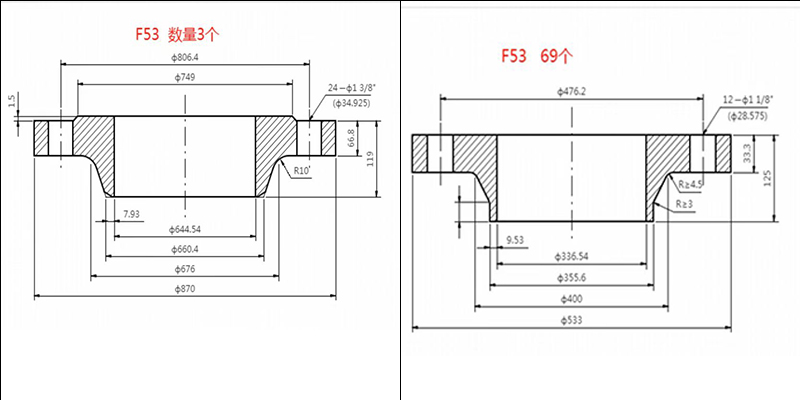
Flanges and forgings | Grade F53 forged flanges | ASTM A182 F53, ASME B16.5 | |
Baffles, tie rods, supports | S32750 where wetted; coated carbon steel elsewhere | TEMA RCB; match galvanic potential | |
Buttweld fittings | S32750 elbows, tees, reducers | ASTM A815 / ASME SA-815 | |
Fasteners | Compatible high-alloy fasteners; never plain carbon steel in seawater | ASTM A193 / A194 or project specification |
One caution from the producer datasheet is worth quoting in the specification: Alleima notes ASME approval of SAF 2507 for Section VIII Division 1 in seamless tube and pipe form, while stating that there is no approval for UNS S32750 in plate form in that particular datasheet.
Code approvals are product-form specific and edition specific. Before naming S32750 plate as a pressure boundary, confirm the listing in the current ASME Section II Part D and the applicable Code case rather than relying on a supplier summary. The duplex designation guide helps keep UNS, ASTM forging and EN names straight in the purchase order.
Yes, and it is often the best-value design - but only with a properly detailed clad or overlay tubesheet, a galvanic assessment, and an expansion check.
Two separate issues decide whether mixed construction works. The first is thermal expansion. The Alleima datasheet gives average thermal expansion coefficients of 13.5 x 10⁻⁶/°C for SAF 2507, 12.5 x 10⁻⁶/°C for carbon steel and 16.5 x 10⁻⁶/°C for 316L over 30 to 100 °C. S32750 and carbon steel therefore grow almost together, which is a genuine advantage over an austenitic tube in a carbon steel bundle: the rolled or welded tube-to-tubesheet joint sees less differential strain during start-up.
The second is galvanic corrosion. In seawater, dissimilar metals in electrical contact form a battery. A large carbon steel water box coupled to small S32750 tube ends is a bad area ratio if the steel is bare and the noble alloy is passive.
The standard answers are a weld overlay or clad tubesheet face, coated or lined carbon steel water boxes, insulating flange kits where the design allows, and sacrificial anodes. Never solve the cost problem by leaving bare carbon steel directly coupled to a small noble area. The S31803 duplex and 316L product pages give context on the lower-alloy alternatives.
Table 9. Mixed-material design checks for an S32750 tube bundle
Check | Data point | Why it matters | Typical response |
|---|---|---|---|
Thermal expansion | S32750 13.5, carbon steel 12.5, 316L 16.5 x 10⁻⁶/°C (30 to 100 °C) | Differential growth loads tube-to-tubesheet joints | Favour S32750 over austenitic tubes in a carbon steel shell |
Galvanic area ratio | Noble S32750 versus active carbon steel in seawater | Small cathode / large anode is safe; large cathode / small anode is not | Clad or overlay the tubesheet, coat the water box, add anodes |
Weld overlay | S32750 overlay on carbon steel tubesheet | Provides a weldable, corrosion-resistant face at lower cost | Qualify the overlay WPS, check bond and thickness |
Hydrotest residue | Chloride-bearing test water left in crevices | Initiates pitting before commissioning | Low-chloride water, drain, rinse and dry immediately |
Identification | Clad plate can be mistaken for solid plate | A wrong repair weld can breach the corrosion barrier | Mark the drawing, PMI the overlay, record heat numbers |
Much thinner than internal pressure alone would require. In a typical 25 mm seawater tube, a 1.0 mm S32750 wall is already far stronger than the cooling-water pressure needs, so vibration, handling, corrosion allowance and the TEMA minimum wall set the real minimum.

This surprises people. Using the familiar ASME B31.3 hoop-stress form P = 2SEt/(D - 2Yt) with an ambient allowable stress S of 267 MPa (38.7 ksi) for UNS S32750, E = 1.0, Y = 0.4, a 25 mm outside diameter, and a 1.0 mm nominal wall reduced by the standard 12.5 % mill tolerance to 0.875 mm, the calculated allowable internal pressure is about 19 MPa, or 190 bar. Seawater cooling circuits normally operate below 10 bar. Pressure is therefore not the constraint on tube thickness.
What actually sets the wall is mechanical and practical: flow-induced vibration across unsupported spans, erosion from sand, the corrosion allowance the owner specifies, the minimum wall in the applicable TEMA class, the tube-to-tubesheet rolling or welding process, bending strain for U-tubes, and handling damage during bundle assembly. Thinner also means more vulnerable to a single deep pit. For that reason the 0.7 to 1.0 mm duplex tube walls quoted in seawater-cooler practice should be read as an indicative band, not a target to minimise. The mechanical properties article explains why the allowable stress falls with temperature.
Table 10. Derived pressure check showing that wall thickness is not pressure-limited
Input | S32750, 1.0 mm wall | 316L, 1.6 mm wall | Comment |
|---|---|---|---|
Ambient allowable stress S | 267 MPa (38.7 ksi) | 115 MPa (16.7 ksi) | ASME B31.3 Table A-1 style values; confirm the Code edition |
Effective wall after 12.5 % tolerance | 0.875 mm | 1.400 mm | Nominal wall x 0.875 |
Outside diameter D | 25 mm | 25 mm | Common heat exchanger tube size |
Derived allowable pressure | About 19 MPa / 190 bar | About 13 MPa / 135 bar | 2SEt/(D-2Yt); illustrative, NOT a Code design |
Actual seawater duty | Usually below 1 MPa / 10 bar | Usually below 1 MPa / 10 bar | Vibration and fouling govern instead |
The wall-resistance gain from a thinner tube is real but modest in the overall heat transfer calculation, because the water films and any fouling layer usually contribute more resistance than the metal wall. Cleanliness and velocity often improve duty more than the alloy change does.
No single standard covers the whole unit. Tubes are bought to ASTM A789 / ASME SA-789, plate and tubesheet to A240 / SA-240, forgings to A182 F53, fittings to A815, and the assembled exchanger to ASME Section VIII Division 1 with TEMA class R, C or B - plus API 660 when a refinery specification calls for it.
The fastest way to lose traceability is to write just 'S32750' on a purchase order. The grade designation is not a product specification. Each component has its own document, its own heat-treatment condition and its own acceptance tests. The Alleima SAF 2507 datasheet lists ASTM A789 and A790 for seamless and welded tube and pipe, A182 for flanges, A182 or A815 for fittings, A240 for plate, sheet and strip, and A479 for bar. A U-tube bend brings in TEMA bend-radius and post-bend heat-treatment rules. A pressure vessel brings in ASME VIII-1, including Appendix rules for tube-to-tubesheet joints and UHX for tubesheet design.
Table 11. Standards map for an S32750 shell-and-tube heat exchanger
Scope | Standard | What it controls | Related JN Alloy page |
|---|---|---|---|
Seamless and welded tubing | ASTM A789 / ASME SA-789 (UNS S32750) | Chemistry, solution anneal and quench, tensile, hardness, flattening, flaring, hydro or NDE of each tube | |
Pipe for nozzles and headers | ASTM A790 / ASME SA-790 | Larger-diameter pressure pipe | |
Plate, tubesheet, channel | ASTM A240 / ASME SA-240 | Plate chemistry, mechanical properties and tolerance | |
Forged flanges and fittings | ASTM A182 Grade F53 | Forging chemistry, heat treatment and mechanical properties | |
Wrought buttweld fittings | ASTM A815 / ASME SA-815 | Elbows, tees, reducers in duplex grades | |
Bar for baffles and studs | ASTM A479 | Bar stock for machined internals | |
Mechanical design of exchanger | ASME BPVC Section VIII Div. 1, UHX | Shell, tubesheet, tube-to-tubesheet joint, pressure test | |
Mechanical standards | TEMA Class R, C or B | Tolerances, baffles, bundle details, U-bend rules | |
Refinery service | API Standard 660 | Additional purchaser requirements for shell-and-tube exchangers | |
Sour service | NACE MR0175 / ISO 15156-3 | Hardness, cold work and environmental limits when H2S is present |
Chemistry and tensile strength alone prove almost nothing about corrosion resistance. The bundle needs an intermetallic-phase check (ASTM A923), a ferric chloride pitting test (ASTM G48 Method A, commonly at 50 °C for super duplex), a measured ferrite fraction (ASTM E562) and low-temperature impact testing.
ASTM A923 was written because a duplex stainless steel can meet every chemical and mechanical requirement and still contain harmful sigma or chi phase. Its methods screen for those phases by metallography, Charpy impact or a corrosion test. That is exactly the failure a heat exchanger cannot tolerate: the tube looks perfect, certificates match, and then it pits or cracks in service because the quench after solution anneal was too slow.
NORSOK M-650 qualification practice for super duplex components adds a consistent package: PREN at or above 40, ferrite content of 35 to 55 % by ASTM E562 point count, no detrimental intermetallic phase by ASTM A923 Method A, ASTM G48 Method A pitting testing with the test temperature fixed in the qualified procedure (50 °C is commonly specified for super duplex - confirm the edition and the project specification), and Charpy V-notch testing at -46 °C with a typical average requirement of 45 J and a minimum single value of 35 J. Exact acceptance values belong in the purchase specification, not in a blog, because they change with edition and product form.
Table 12. Acceptance tests that actually protect a heat exchanger bundle
Test | Method | Typical target | What it catches |
|---|---|---|---|
Intermetallic phase | ASTM A923 Method A, B or C | No detrimental intermetallic phase | Slow quench, sigma and chi phase, lost toughness and corrosion resistance |
Pitting corrosion | ASTM G48 Method A | Test temperature per qualified procedure, commonly 50 °C for super duplex; no pitting | Wrong solution anneal, surface contamination, wrong heat |
Ferrite fraction | ASTM E562 point count | About 35 to 55 % in base metal; 35 to 65 % often allowed in weld metal | Excess ferrite from fast cooling or a bad weld procedure |
Impact toughness | ASTM A370, Charpy V at -46 °C | Average about 45 J, single value about 35 J (project dependent) | Embrittlement from thermal exposure |
Hardness | ASTM E18 / ISO 6508 | About 32 HRC max general; 28 HRC max for NACE sour service | Cold work and unannealed material |
Hydrostatic or NDE of each tube | ASTM A450 / A789 requirements | Each tube pressure-tested or examined by eddy current | Through-wall defects before the bundle is built |
Documentation | EN 10204 Type 3.1 or 3.2 | Heat number, chemistry, mechanicals, heat treatment, test results | Traceability gaps between plate, tube, forging and weld |
JN Alloy documents its in-house testing capability on the company page, and the F53 quick questions and FAQ library pages carry the short-form answers for buyers. The S32750 properties article collects the numeric property data.

Use a welded, crevice-free joint - seal weld plus controlled expansion for normal service, or a full strength weld for high pressure, high temperature differential or lethal service - and qualify the orbital welding procedure on the real tube and tubesheet combination.
The tube-to-tubesheet joint is where most seawater exchangers leak. Three options exist: expansion only, seal welding after expansion, and strength welding where the weld carries the load. ASME VIII-1 addresses tube-to-tubesheet welds through UW-38 and the applicable appendix, and clad tubesheets through UCL-35. A seal weld is commonly specified at least as thick as the smaller of 3 mm or the tube wall. For thin super duplex tubes that usually means an autogenous orbital GTAW weld with no filler, which avoids introducing a second alloy into an already sensitive joint.
Two metallurgical rules apply. First, the joint must be crevice-free: a partly rolled tube leaves an annular gap that becomes an oxygen-depleted cell. Second, no post-weld heat treatment. Stress-relief temperatures used for carbon steel sit exactly in the range where duplex stainless steels precipitate intermetallic phases. If a thermal cycle has gone wrong, the remedy is a full solution anneal and water quench of the component, not a sub-critical stress relief. The cross-cluster Inconel 625 welding guide and Hastelloy C276 welding guide show the same discipline applied to nickel alloys; for prefabrication logistics see the pipe spool fabrication article.
Table 13. Tube-to-tubesheet joint options for an S32750 seawater bundle
Joint | Load path | Crevice risk | Use when | Avoid when |
|---|---|---|---|---|
Expansion only | Rolled or hydraulically expanded tube | High - annular gap remains | Clean, non-corrosive, low-pressure utility duty | Any chloride water service |
Expanded plus seal weld | Roll carries load; weld seals | Low if fully fused and crevice-free | Most seawater and brine coolers | Severe thermal cycling without requalification |
Strength weld | Weld carries the tube load | Lowest when full penetration | High pressure, large temperature difference, toxic or lethal service | Thin walls without a qualified orbital WPS |
Explosion or hydraulic expansion plus weld | Hybrid | Depends on final geometry | Thick tubesheets, high pull-out load | Uncontrolled expansion that work-hardens the tube |
Controlled heat input, a low interpass temperature, no preheat, no post-weld heat treatment, matching ER2594 filler and a clean argon back-purge. Get the cooling rate wrong and the corrosion resistance you paid for disappears in the weld.

S32750 is about half ferrite and half austenite. Welding melts that balance and rebuilds it during cooling. Cool too fast and there is too much ferrite and nitrogen loss; cool too slowly and sigma and chi phases precipitate. Both reduce toughness and localised corrosion resistance, and neither is visible on a finished bead. The Alleima SAF 2507 datasheet recommends a heat input of 0.2 to 1.5 kJ/mm and an interpass temperature below 150 °C, with GTAW/TIG as the first-choice process and ER2594 (ISO 14343 S 25 9 4 N L) wire or E2594 covered electrodes. Other super duplex fabrication guides quote 0.5 to 1.5 kJ/mm - treat the range as a WPS window to be qualified, not a universal setting.
Back-purging matters on tube and nozzle welds. Argon, not nitrogen, is used for stainless and duplex root protection; nitrogen can be absorbed into the weld pool. Heat tint must be removed by pickling or passivation because the oxidised surface has a much weaker passive film. Dedicated stainless tooling avoids iron contamination, which otherwise rusts and seeds pits. These are procedure-qualification problems, not operator skill problems - the S32750 material guide and composition spoke explain the phase balance behind them.
Table 14. Welding parameter window for S32750 exchanger fabrication
Parameter | Working window | Why | If ignored |
|---|---|---|---|
Heat input | 0.2 to 1.5 kJ/mm (Alleima); 0.5 to 1.5 kJ/mm commonly quoted | Controls cooling rate and phase balance | Sigma phase or excess ferrite |
Interpass temperature | Below 150 °C, often specified at or below 100 °C | Limits time in the precipitation range | Loss of toughness and pitting resistance |
Preheat | None | Unnecessary and slows cooling | Longer time at harmful temperatures |
Post-weld heat treatment | Not permitted; full solution anneal if a cycle was wrong | Sub-critical stress relief precipitates intermetallics | Embrittlement |
Filler | ER2594 / E2594 (25Cr-9Ni-4Mo-N), or autogenous orbital GTAW for thin tubes | Overmatching chemistry restores austenite and PREN | Undermatching weld corrodes first |
Shielding and purge | Argon; controlled nitrogen only where the WPS specifies it in shielding gas | Protects the root and controls nitrogen loss | Root oxidation, crevice initiation |
Cleaning | Stainless-only tools, pickling or passivation after welding | Restores the passive film | Iron contamination and heat tint pitting |
By leaving chloride-bearing test water sitting in crevices. Use low-chloride water, drain completely, rinse and dry immediately, and never leave a super duplex bundle wet and stagnant during lay-up.
Hydrostatic pressure testing is a Code requirement, not an option. ASME VIII-1 UG-99 uses 1.3 times the maximum allowable working pressure adjusted by the stress ratio; ASME B31.3 uses 1.5 times design pressure with a stress-ratio adjustment capped at 6.5, holds for at least 10 minutes, then reduces to design pressure for examination. Neither Code sets a chloride limit on the test water - the commonly quoted 50 ppm, or 25 to 30 ppm, figures are owner and EPC specification numbers. Say so explicitly in the procedure rather than pretending the Code wrote them.
Super duplex is particularly sensitive to the period AFTER the test, because a bundle has hundreds of crevices that trap water. Specify low-chloride water, a short hold, complete drainage through every vent and drain, a demineralised-water rinse, and forced air drying. The same rule applies to shutdowns: a wet, stagnant, unchlorinated or biologically active bundle can pit within weeks. The water treatment and chemical equipment pages cover the plant-side context, and the F53 quick questions page collects common field queries.
Table 15. Hydrotest, commissioning and lay-up checklist
Stage | Requirement | Typical figure | Failure prevented |
|---|---|---|---|
Test pressure | ASME VIII-1 UG-99 | 1.3 x MAWP x stress ratio | Under-testing a pressure boundary |
Test pressure, piping | ASME B31.3 | 1.5 x design pressure, ratio cap 6.5, hold at least 10 min | Missed joint leakage |
Test water | Owner or EPC specification | Low chloride; 50 ppm or 25 to 30 ppm are common project limits | Pitting during the test |
After the test | Drain, rinse, dry | No standing water anywhere in the bundle | Stagnant crevice attack |
Commissioning | Ramp flow and chlorination gradually | Keep velocity above about 1 m/s | Deposit and under-deposit corrosion |
Shutdown / lay-up | Flush, drain, dry or circulate | No stagnant seawater | Microbiologically influenced corrosion |
Records | Signed test pack | Pressure, duration, water analysis, drying record | Unproven acceptance at handover |
Any duty that combines chloride water with pressure and a temperature below about 40 °C on the water side: seawater cooling, desalination brine service, offshore produced-water and gas coolers, chemical brine condensers, FGD quench and pulp mill bleach plant exchangers.

The pattern is easier to remember than a list of industries: S32750 earns its place when the cooling side is seawater or concentrated brine, when a leak would be expensive, and when pressure or weight favours a strong, thin-wall tube. Where the process side is a hot reducing acid instead, a nickel alloy usually takes over. The oil and gas, desalination and offshore spokes in this cluster each cover one of those industries in depth; this article supplies the equipment-level view that links them.
Table 16. Industry x duty map for S32750 heat exchangers
Industry | Typical exchanger duty | Tube-side fluid | Why S32750 |
|---|---|---|---|
Offshore oil and gas | Produced-water coolers, gas coolers, seawater lift coolers | Seawater or produced brine | Chloride resistance plus strength and weight saving |
Desalination | Brine heaters, MED/MSF evaporator bundles, SWRO energy-recovery exchangers | Concentrated warm brine | Higher PREN than 2205; resists hot concentrated chloride |
Power and coastal industry | Auxiliary seawater coolers, lube oil coolers | Raw or chlorinated seawater | Erosion and crevice resistance with thin walls |
Chemical processing | Chloride brine coolers, acid gas condensers | Chloride-bearing process water | Duplex structure resists chloride stress-corrosion cracking |
Flue gas desulfurisation | Quench and reheat exchangers | Acidic chloride slurry condensate | Handles low pH chloride at moderate temperature |
Pulp and paper | Bleach plant and black liquor heat recovery | Chloride / chlorine dioxide-bearing liquors | Resists oxidising chloride media better than 316L |
Marine and shipbuilding | Central coolers, ballast water treatment heat exchangers | Seawater, often chlorinated | High velocity tolerance, no copper discharge |
For cross-cluster comparisons, the Inconel 625 for heat exchangers page is the nickel-alloy view of the same equipment, and the seawater piping material guide covers the connected pipework. JN Alloy's market overview lists the sectors supplied.
Above 250 °C for long-term service, in hot chlorinated seawater, in strong reducing acids, where zero probability of a tube leak is required, or where biofouling control without chlorination is the dominant requirement.
Being honest about the boundaries is what makes a specification credible. Super duplex is not a universal corrosion answer. Long-term exposure above about 250 °C changes the microstructure and lowers toughness. Hot oxidising seawater attacks the welds before it attacks the parent metal. Hydrochloric and hot concentrated reducing acids belong to Hastelloy C276 or Incoloy 825 territory. Where any tube perforation is unacceptable - a naval or nuclear duty, for example - titanium is the technical answer despite its cost. And where copper-ion biofouling control matters more than strength, 90/10 copper-nickel remains a legitimate choice.
Table 17. When NOT to specify S32750, and what to consider instead
Condition | Why S32750 is wrong | Better direction | Reference |
|---|---|---|---|
Sustained metal temperature above 250 °C | Sigma, chi and 475 °C embrittlement reduce toughness over time | Austenitic stainless or a nickel alloy rated for the temperature | |
Chlorinated seawater above about 40 °C or frequent hot upsets | Weld pitting and crevice corrosion initiate and may not repassivate | Titanium or a 6Mo / nickel upgrade after testing | |
Hydrochloric or hot reducing acid on the process side | Passive film is not stable in strongly reducing acid | C276, C22 or Alloy 20 depending on acid and temperature | |
Zero-tolerance tube leakage, inaccessible bundle | Any passive alloy can pit at a crevice | Titanium Grade 2 tubes | |
Biofouling control must work without chlorination | Stainless steels have no inherent antifouling action | 90/10 or 70/30 copper-nickel | |
Freshwater, low-pressure, low-chloride utility duty | The alloy premium buys nothing | 316L or 2205 | |
S32750 plate as a Code pressure boundary without confirming the listing | ASME approvals are product-form and edition specific | Confirm Section II Part D and the applicable Code case |

S32750 is the best strength-to-chloride-resistance compromise for a pressurised seawater exchanger. 316L is cheaper but pits, 2205 is borderline warm, 6Mo resists pitting but is weaker, copper-nickel fouls less but erodes sooner, titanium is immune but costly, and C276 solves acids rather than seawater.
No comparison table should be read as a purchase decision without the actual water analysis, but the ranking is stable. PREN predicts pitting resistance, proof strength sets wall thickness, thermal conductivity is nearly the same for all stainless grades, and the seawater temperature ceiling is set by crevice and weld behaviour rather than PREN. Use the dedicated comparison spokes - S32750 vs 316L, S32750 vs 2205, S32750 vs S32760 and the F53 vs F55 technical comparison - for the full argument.
Table 18. Seven-way material comparison for seawater heat exchanger duty
Material | PREN (approx.) | Proof strength | Thermal conductivity | Chlorinated seawater limit | Relative cost | Best fit |
|---|---|---|---|---|---|---|
316L | ~25 | ~170 MPa | ~14 W/m·K | Poor; pits and crevice-corrodes | 1.0 | |
Duplex 2205 | ~35 | ~450 MPa | ~15 W/m·K | Borderline above about 30 °C | 1.3 to 1.8 | |
254 SMO / 6Mo | ~43 | ~300 MPa | ~14 W/m·K | About 30 to 35 °C in chlorinated water | 2.4 to 2.8 | |
Super duplex S32750 | ~41 to 43 | ~550 MPa | ~14 W/m·K | About 40 °C; weld pitting governs | 2.3 to 2.7 | |
90/10 Cu-Ni | Not applicable | ~100 to 150 MPa | ~40 W/m·K | Good but velocity limited | 2.2 to 2.6 | Biofouling-critical, low-velocity circuits |
Titanium Gr 2 | Immune | ~275 to 345 MPa | ~16 W/m·K | Essentially immune at any practical temperature | 5 to 6 | Zero-failure and high-velocity bundles |
Hastelloy C276 | ~65 to 70 | ~283 MPa | ~10 W/m·K | Excellent but uneconomic for clean seawater | 6 to 8 |
PREN values, cost ratios and temperature ceilings above are indicative bands compiled from producer datasheets and published marine-corrosion reviews. They are screening numbers. Confirm the chemistry limits, the Code allowable stresses and the project corrosion test requirements against the current editions before ordering.
S32750 costs roughly two to three times 316L by material weight but usually wins over a 20-year life because the largest cost in a failed seawater cooler is the unplanned shutdown, not the tube bundle.
A fair comparison has four terms: initial bundle price, planned inspection and cleaning, retubing or replacement frequency, and the production loss from an unplanned leak. The first term favours 316L. Every other term favours the alloy that does not pit. Published seawater-cooler experience puts a 316L bundle on a 5 to 10 year replacement cycle while a properly fabricated duplex bundle is quoted at 20 to 25 years; those are industry rules of thumb, not warranties, and they depend entirely on water chemistry and fabrication quality.
Two secondary effects help. A stronger, thinner tube weighs less and needs less support steel, which matters offshore. And a tube that stays clean holds its design heat-transfer coefficient, so the unit does not slowly lose capacity. Against titanium, S32750 is usually the lower-capital option; against copper-nickel it avoids copper discharge restrictions. The plate buying guide and thickness selection guide gie useful framing on how specifications move price, though they are written for plate rather than tube.
Table 19. Lifecycle cost structure - a framework, not a quotation
Cost element | 316L | S32750 | Titanium | Comment |
|---|---|---|---|---|
Initial bundle material | Lowest | About 2 to 3 x 316L | About 5 to 6 x 316L | Moves with nickel and molybdenum prices |
Tube wall and weight | Thicker | Thinner, lighter | Thinnest | Strength and corrosion allowance both matter |
Expected retubing interval | Shortest in seawater | Long | Longest | Site water chemistry dominates |
Inspection burden | High once pitting starts | Eddy current and visual at planned intervals | Low | Specify a baseline survey at commissioning |
Unplanned shutdown | Highest risk | Low | Lowest | Usually the largest number in the model |
Best-value window | Clean freshwater | Chloride water at pressure below 250 °C | Any leak is unacceptable | Choose by consequence of failure |
They show that the decisive deliverable is documentation and traceability across product forms - tubes, fittings, flanges and forgings - because an exchanger bundle combines all of them under one heat-number trail.
An exchanger is assembled from several supply chains. A tube mill, a plate rolling mill, a forging shop and a fittings maker all produce material that ends up in one pressure boundary. Published shipment records from JN Alloy illustrate the point: 84 pieces of UNS S32750 buttwelding pipe fittings shipped to Saudi Arabia, ASTM A815 UNS S32750 super duplex pipe fittings shipped to Brazil and 153 pieces of F53 weld neck flanges shipped to Argentina. Each is a different product form of the same UNS designation, and each carries its own heat number, heat treatment and test certificate.
For a buyer the practical lesson is to ask for one documentation package, not four. The bundle dossier should reconcile the EN 10204 3.1 or 3.2 certificates for tubes, tubesheet plate, forgings and fittings, the welding procedure qualifications, the ASTM A923 / G48 / E562 results, and the final hydrotest and drying record. Cross-cluster shipment examples such as the Inconel 625 pipe spools for an LNG facility in Malaysia and the 254 SMO plate shipment show the same discipline applied to nickel and 6Mo projects. The S32750 heat exchanger product page is the equipment anchor for these supply records.
Table 20. Shipment evidence and what it proves for an exchanger project
Published shipment | Product form | Relevance to a heat exchanger | Ask for |
|---|---|---|---|
84 pcs UNS S32750 buttwelding fittings to Saudi Arabia | Buttweld fittings | Nozzle and header connections on the aggressive side | A815 certificate, heat number, PMI record |
ASTM A815 S32750 fittings shipped to Brazil | Duplex pipe fittings | Standardised fitting chemistry and heat treatment | Solution anneal and quench record, A923 where specified |
153 pcs F53 weld neck flanges to Argentina | Forged flanges | Channel and shell flanges, gasket faces | A182 F53 certificate, hardness, impact results |
Inconel 625 pipe spools for an LNG facility in Malaysia | Prefabricated spools | Example of a fully documented package across welds | WPS/PQR, NDE map, weld map |
254 SMO plate shipment | 6Mo plate | Comparison case for crevice-limited plate service | Plate certificate and surface condition record |

Localised, not uniform, attack: crevice corrosion at tube-to-tubesheet joints, under-deposit pitting in low-flow zones, weld-root attack from heat tint, and intermetallic embrittlement from a bad thermal cycle.
A well-made S32750 tube does not waste away evenly. It stays bright almost everywhere and then leaks at one small location. That is why an inspection plan built around general wall-loss measurements will miss the problem. A baseline eddy current survey at commissioning, followed by repeat surveys at planned intervals, gives something to compare against. Borescopy and dye penetrant examination of tube-to-tubesheet welds, plus attention to the water outlet end and low-flow pockets, target the sites where attack actually starts. The corrosion resistance spoke explains the mechanisms and the F53 quick questions page collects the field symptoms.
Table 21. Failure mode, location, detection and corrective action
Failure mode | Where it starts | How to detect | Corrective action |
|---|---|---|---|
Crevice corrosion | Tube-to-tubesheet annulus, gasket faces, baffle contact | Borescopy, dye penetrant, leak test, tube pull-out sample | Redesign the joint to be crevice-free; review gasket and velocity |
Under-deposit pitting | Low-flow tube inlets, silt pockets, dead legs | Eddy current, visual inspection after cleaning | Improve filtration, velocity and cleaning; flush during shutdown |
Weld-root / heat-tint attack | Orbital tube welds, nozzle welds, root purge failures | Borescopy, dye penetrant, ferrite check | Re-qualify purge and WPS; pickle and passivate |
Intermetallic embrittlement | Slow-cooled welds, hot-formed bends, wrong anneal | ASTM A923 screening, Charpy, metallography | Full solution anneal and water quench; scrap non-conforming parts |
Chloride pitting from test water | Anywhere water was left standing | Baseline eddy current comparison | Revise hydrotest and drying procedure |
Galvanic attack | Bare carbon steel water box coupled to noble tubes | Visual and thickness survey of the anode | Coat or line, add anodes, review insulation |
Erosion-corrosion | Tube inlets, high-velocity sand-laden zones | Eddy current at inlets, inlet ferrule inspection | Add filtration, reduce velocity, fit inlet ferrules |
Specify the duty, the acceptance tests and the documents - not just the grade. A purchase order that says only 'S32750 tubes' gives the supplier no way to fail and the buyer no way to prove the bundle was made correctly.
Start with both fluids: chloride concentration, temperature at inlet and outlet, pH, chlorination dose, suspended solids, H2S if sour, design pressure and temperature, and the expected upset conditions. Then fix the product-form standards, the heat-treatment condition, the joint design, the welding controls, and the exact test package with acceptance values. Finish with the documentation and the preservation procedure. The JN Alloy contact page is the route to a quotation; the plate buying guide and B36.19M dimension guide show how much detail a useful enquiry contains.
Table 22. RFQ checklist for an S32750 heat exchanger bundle
Item | What to state | Why |
|---|---|---|
Fluid chemistry | Chloride, pH, chlorine dose, H2S, solids, both sides | Sets the corrosion envelope and the seawater temperature ceiling |
Temperature | Normal inlet and outlet, plus maximum upset | Weld pitting and repassivation depend on the worst excursion |
Design conditions | Pressure, temperature, Code edition, TEMA class | Fixes the mechanical design basis |
Material scope | Which components are S32750, which are clad or carbon steel | Prevents an ambiguous mixed-material bundle |
Product standards | SA-789 tubes, SA-240 plate, A182 F53 forgings, A815 fittings | Makes each component traceable to a specification |
Heat treatment | Solution annealed and water quenched; state the range and quench | The single biggest variable in corrosion performance |
Acceptance tests | A923, G48 Method A temperature, E562 ferrite, Charpy, hardness | Proves the microstructure, not just the chemistry |
Joint design | Seal or strength weld, expansion method, crevice-free detail | Targets the most common leak path |
Welding controls | Heat input, interpass, filler, purge, heat-tint removal | Protects the ferrite-austenite balance |
Hydrotest and drying | Pressure, water chloride limit, drain and dry method | Prevents pitting before handover |
Documentation | EN 10204 3.1 or 3.2, PMI, weld map, NDE records, test pack | Creates the traceability an auditor will ask for |
Preservation | Packaging, shipping, lay-up and commissioning procedure | Covers the period most often forgotten |
The hub answers 'what is this alloy', the technical spokes answer 'why', the application spokes answer 'where', the product pages answer 'what form can I buy', the shipment records answer 'has it been delivered', and the FAQ pages answer the short questions. This article links to all five layers.
That five-layer structure is what turns a set of blog posts into a topic cluster: Hub to Blog, Blog to Product, Product to Case Study, and every layer cross-linked to the FAQ. Search engines use the links to establish the hub as the authority page; AI answer engines use the same structure to locate a citable, self-contained answer. Below is the map for this spoke.
Table 23. Cluster map - Hub and Blog layers
Layer | Page | Question it answers |
|---|---|---|
Hub | The complete reference for the grade | |
Blog / fundamentals | Names, UNS and grade identity | |
Blog / fundamentals | Element limits and PREN | |
Blog / fundamentals | Strength, hardness and impact values | |
Blog / fundamentals | Pitting, crevice and SCC behaviour | |
Blog / comparisons | Which super duplex, and why | |
Blog / comparisons | When standard duplex is enough | |
Blog / comparisons | When the upgrade pays | |
Blog / applications | Marine exposure and structures | |
Blog / applications | Brine and evaporator duty | |
Blog / applications | Sour service and process-side duty | |
Blog / technical | Deep process engineering reference | |
Blog / technical | Forms, heat treatment and traceability | |
Blog / technical | Physical and mechanical data | |
Blog / adjacent | The nickel-alloy alternative |
Table 24. Cluster map - Product, Case Study and FAQ layers
Layer | Page | What the reader gets |
|---|---|---|
Product | The equipment-level supply page | |
Product | All available forms | |
Product | Plate and tubesheet stock | |
Product | Tube and pipe forms | |
Product | Sheet, plate and channel material | |
Product | Bar for baffles and machined parts | |
Product | Elbows, tees and reducers | |
Product | Forged pressure-boundary parts | |
Product | Pipe specification detail | |
Case Study | Shipment evidence for a hot, chloride market | |
Case Study | Certified buttweld fitting delivery | |
Case Study | Forged component traceability | |
Case Study | Cross-cluster documentation example | |
FAQ | Short answers across products | |
FAQ | Grade-specific quick answers | |
FAQ | The cluster's consolidated FAQ |
To move from reading to buying, use the contact page with the product range and markets served pages as a shortlist. For adjacent fabrication questions see the prefabrication service and pipe spool fabrication articles.
Fix the duty, then the crevice geometry, then the material scope, then the acceptance tests, then the documentation. Decide the test and inspection package before the order is placed, because most of it cannot be added afterwards.
The sequence below is written in the order a buyer would actually execute it. It is deliberately independent of any one Code edition or supplier, so it can be attached to an enquiry for tubes, a tube bundle or a complete exchanger. The Super Duplex S32750 hub is the starting point for the underlying metallurgy.
Define both fluids. Record chloride, pH, chlorination dose, suspended solids, H2S if sour, and the normal and upset temperatures for BOTH sides. Start from the Super Duplex S32750 hub and the corrosion resistance spoke.
Find the governing temperature. Compare the outlet water temperature with the roughly 40 °C chlorinated-seawater limit, and the metal temperature with the 250 °C long-term pressure-vessel ceiling. The lowest applicable number governs.
Map the crevices. List tube-to-tubesheet joints, baffles, gasket faces, support plates, dead legs and deposit traps. Decide how each is made crevice-free before choosing a grade.
Choose the material scope. Decide component by component which parts are solid S32750, which are clad or overlaid carbon steel, and which stay carbon steel. Use the A240 plate and duplex tube pages to fix the product forms.
Fix the standards and wall. Name SA-789 for tubes, SA-240 for plate, A182 F53 for forgings and A815 for fittings. Set wall thickness from the Code, TEMA minimum, vibration and corrosion allowance - not from pressure alone. The B36.19M dimension guide is a useful check.
Specify the test package. Call out ASTM A923, G48 Method A with its test temperature, E562 ferrite fraction, Charpy impact, hardness and EN 10204 3.1 or 3.2 certificates. The S32750 properties page collects the numeric background.
Control fabrication. Qualify the orbital tube-to-tubesheet weld, set heat input and interpass limits, require argon purging and heat-tint removal, and prohibit post-weld heat treatment.
Control the handover. Specify low-chloride hydrotest water, immediate drain and dry, a baseline eddy current survey, a preservation and lay-up procedure, and one reconciled documentation pack. Shipment evidence is documented in the S32750 fittings case and the F53 flange shipment.
Core keyword | heat exchanger applications of S32750 |
Long-tail keywords | S32750 heat exchanger tube, super duplex seawater cooler, ASTM A789 S32750 tubing, S32750 tubesheet, S32750 condenser tubes, super duplex heat exchanger temperature limit, S32750 vs titanium seawater cooler |
Search intent | Commercial investigation and technical specification (mid-funnel) |
Funnel stage | Consideration to specification - reader has a duty and is choosing a tube material |
Schema types | Article, BreadcrumbList, FAQPage, HowTo, ItemList (cluster map); Product markup belongs on the linked product pages, not on this article |
Primary entity | Super Duplex S32750 / UNS S32750 / 2507 / F53 / EN 1.4410 |
Equipment scope | Shell-and-tube and plate heat exchangers, coolers, condensers, brine heaters |
Governing tube spec | ASTM A789 / ASME SA-789, UNS S32750, solution annealed and water quenched |
Thermal conductivity | About 14 W/m·K at 20 °C - the same as 316L in producer data |
Proof strength | About 550 MPa minimum at room temperature, roughly 3 times 316L |
Thermal expansion | 13.5 x 10⁻⁶/°C (30 to 100 °C) versus 12.5 for carbon steel and 16.5 for 316L |
Three temperature ceilings | 316 °C end of ASME B31.3 allowables; 250 °C pressure-vessel service ceiling; about 40 °C in chlorinated seawater |
Acceptance tests | ASTM A923, ASTM G48 Method A, ASTM E562 ferrite, Charpy at -46 °C, hardness, EN 10204 3.1 or 3.2 |
Welding window | 0.2 to 1.5 kJ/mm, interpass below 150 °C, ER2594 filler, no PWHT, argon purge |
Hub | Ultimate Guide to Super Duplex S32750 |
Cluster layers | Hub, Blog, Product, Case Study and FAQ - all cross-linked from this article |
What is S32750 used for in a heat exchanger?
It is used for tubes, tubesheets, channel heads, nozzles and fittings on the chloride-bearing side of shell-and-tube and plate exchangers. Typical duties are seawater coolers, desalination brine heaters and offshore produced-water coolers. The grade is chosen for pitting and crevice resistance plus high strength, not for better heat conduction.
Does S32750 conduct heat better than 316L?
No. Producer datasheets list SAF 2507 and ASTM 316L with the same thermal conductivity: about 14 W/m·K at 20 °C rising to about 20 W/m·K at 400 °C. The efficiency gain comes from a thinner tube wall made possible by about 550 MPa minimum proof strength, and from cleaner surfaces that stay free of corrosion products.
What is the maximum temperature for an S32750 heat exchanger?
Three ceilings apply. ASME B31.3 tabulates allowable stresses up to 316 °C, VdTÜV-Wb 508 and NGS 1609 set a 250 °C maximum for pressure vessel service because of long-term embrittlement, and published super duplex data puts the practical ceiling in chlorinated seawater at about 40 °C because of weld pitting. Use the lowest applicable one.
Can S32750 be used with chlorinated seawater?
Yes, within limits. Chlorination suppresses biofouling but raises the corrosion potential and increases crevice-corrosion risk. Published marine-corrosion work on super duplex grades recommends designing to roughly 40 °C at the water outlet, avoiding stagnant zones and keeping the dose as low as the fouling-control programme allows.
Which ASTM standard covers S32750 heat exchanger tubes?
ASTM A789 and its ASME counterpart SA-789 cover seamless and welded ferritic-austenitic stainless steel tubing, including UNS S32750. Larger-diameter pipe for nozzles and headers is normally bought to ASTM A790 or SA-790. Plate for the tubesheet is ASTM A240 or SA-240, and forged flanges are ASTM A182 Grade F53.
Can a carbon steel shell be used with S32750 tubes?
Yes, and it is often the most economical design, provided the tubesheet face is clad or weld-overlaid with S32750 and galvanic compatibility is managed. S32750 expands at 13.5 x 10⁻⁶/°C against 12.5 for carbon steel, so differential growth is small. Bare carbon steel water boxes should be coated, lined or protected with anodes.
How thin can an S32750 heat exchanger tube wall be?
Seawater cooler practice quotes about 0.7 to 1.0 mm for 19 to 25 mm duplex tubes, against roughly 1.2 to 1.6 mm for 316L. Internal pressure is rarely the limit: a derived B31.3 check on a 25 mm tube with a 1.0 mm wall gives roughly 190 bar. Vibration, handling, TEMA minimum wall and corrosion allowance set the real minimum.
What is PREN and why does it matter for a seawater cooler?
PREN is the pitting resistance equivalent number, commonly calculated as chromium plus 3.3 times molybdenum plus 16 times nitrogen. S32750 scores about 41 to 43, against roughly 35 for 2205 and 25 for 316L. It ranks resistance to pitting, but it does not predict crevice corrosion, weld behaviour or the effect of chlorination.
How is sigma phase avoided in S32750 fabrication?
By solution annealing at roughly 1025 to 1125 °C followed by a rapid water quench, and by keeping welding heat input low with an interpass temperature below 150 °C. Time in the 600 to 1000 °C band must be minimised. ASTM A923 testing then screens the finished material for detrimental intermetallic phases.
Is post-weld heat treatment allowed for S32750?
No. A conventional carbon steel stress relief sits inside the temperature range where duplex stainless steels precipitate sigma and chi phases. Correctly welded S32750 is left in the as-welded condition. If a thermal cycle was wrong, the remedy is a full solution anneal and water quench of the whole component, not a sub-critical treatment.
What filler metal is used for S32750 tube-to-tubesheet welds?
Thin tube-to-tubesheet welds are normally autogenous orbital GTAW with no filler. Where filler is needed, a matching 25Cr super duplex consumable such as ER2594 or E2594 is used, so the weld metal keeps the austenite-ferrite balance and PREN. Argon is used for back-purging; nitrogen is not used as a stainless backing gas.
Which tests should be on the S32750 mill certificate?
At minimum: heat number, chemical analysis, tensile and hardness results, solution anneal and quench condition, and the specified corrosion and microstructural tests. For a qualified super duplex project, expect ASTM A923, ASTM G48 Method A pitting, ASTM E562 ferrite fraction, Charpy impact at -46 °C and EN 10204 Type 3.1 or 3.2 certification.
What is ASTM A923 and why is it required?
ASTM A923 detects detrimental intermetallic phases in duplex stainless steels. It exists because material can meet every chemical and mechanical requirement and still contain sigma or chi phase from a slow quench. Its methods use metallography, impact testing or a corrosion test, and sampling should target the slowest-cooled region of the component.
What is ASTM G48 Method A and what temperature is used?
Method A is a ferric chloride pitting test used as a quality screen for duplex and super duplex stainless steel. For super duplex, 50 °C is commonly written into NORSOK M-650 qualified procedures, with no pitting and a weight-loss criterion. The exact temperature and acceptance criteria belong in the project specification and must follow the current standard edition.
Why do S32750 exchangers leak at the tubesheet?
Because the tube-to-tubesheet annulus is a crevice. Water enters but cannot circulate, oxygen is depleted, chloride concentrates and the passive film breaks down. A partly expanded tube without a full seal weld is the classic cause. Full-penetration seal or strength welds, controlled expansion and crevice-free detailing are the remedy.
What chloride level is allowed in hydrotest water?
No piping or vessel Code sets a chloride number. The frequently quoted 50 ppm or 25 to 30 ppm limits are owner and EPC specification values. State the project limit explicitly, use low-chloride water, drain every vent and drain point, rinse with demineralised water and dry the bundle immediately after the test.
How should an S32750 exchanger be laid up during a shutdown?
Never leave it full of stagnant seawater. Flush with low-chloride water, drain completely, rinse and force-air dry, or keep the circuit circulating with treated water. Stagnant, warm, biologically active water creates under-deposit and microbiologically influenced corrosion even in a high-alloy stainless steel.
Is S32750 better than titanium for seawater cooling?
It is cheaper and stronger, but titanium is essentially immune to seawater pitting and crevice attack at any practical velocity or temperature. S32750 is the better commercial choice for most pressurised seawater coolers. Titanium wins when any tube leak is unacceptable, when the bundle is inaccessible, or when chlorinated water runs hot.
When should I choose 2205 instead of S32750?
When seawater is cool, chloride is moderate, chlorination is absent and pressure is modest. Duplex 2205 has a PREN around 35 and a lower price. Above roughly 30 °C in chlorinated seawater, or where a leak would be costly, super duplex is the safer selection.
Can S32750 handle hydrochloric acid on the process side?
No. Super duplex stainless steel relies on a passive chromium oxide film, which is not stable in hot reducing acids such as hydrochloric acid. Those duties belong to nickel alloys such as Hastelloy C276 or C22, or to Alloy 20 in sulfuric acid. S32750 is a chloride-water alloy, not a general acid alloy.
What documents should come with an S32750 tube bundle?
One reconciled pack covering every product form: EN 10204 3.1 or 3.2 certificates for tubes, plate, forgings and fittings; WPS and PQR; weld and NDE maps; A923, G48, E562, Charpy and hardness results; PMI records; and the hydrotest, water analysis and drying record. The whole bundle must trace to one heat-number trail.
Where can I find the full Super Duplex S32750 reference and FAQ?
The Ultimate Guide to Super Duplex S32750 is the hub for the whole cluster, and the JN Alloy FAQ library plus the About Duplex F53 quick questions page hold the short answers. From there the corrosion resistance, mechanical properties and application spokes cover the detail; the S32750 product hub and the heat exchanger product page cover what can actually be supplied.


